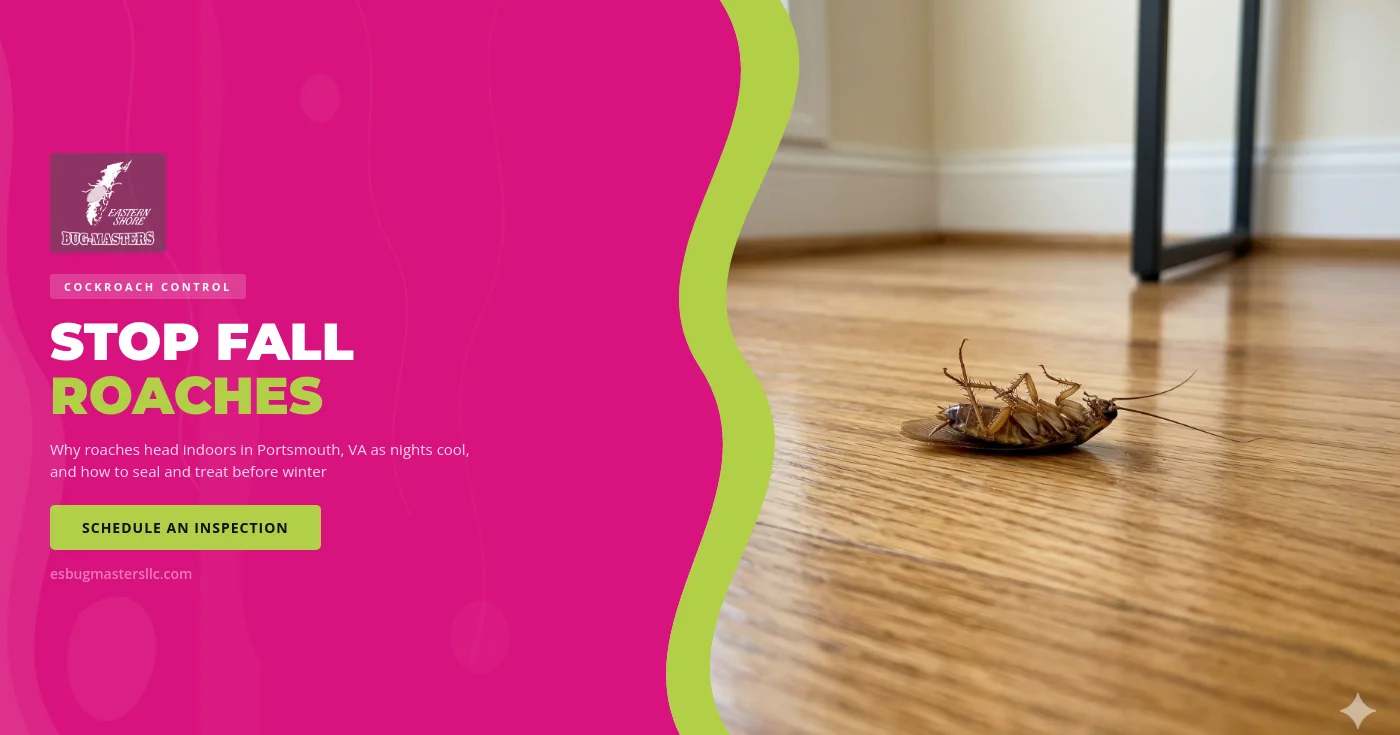
When the first crisp October evenings settle over Portsmouth, many homeowners spot something they didn’t expect. It might be a large reddish-brown roach darting across the kitchen tile, or a dark, glossy one fluttering toward the porch light. If you’ve been looking into cockroach control Portsmouth VA homeowners can rely on this fall, you’re asking the right question at the right time.
Here at Eastern Shore Bug Masters, we hear the same story every autumn: “I barely saw a roach all summer, and now they’re everywhere.” Finding cockroaches in the house in fall isn’t a coincidence. As nights cool, the American cockroach and the smoky brown cockroach start looking for warmer, damper shelter. These two big outdoor species thrive in the humid Hampton Roads climate, and older homes often give them an easy way in.
In this post we’ll explain why roaches head indoors this time of year and how to tell the two main fall invaders apart. We’ll also cover where they sneak in, a practical fall cockroach prevention checklist, and when it makes sense to bring in professional help.
Cockroaches are cold-blooded, so their activity rises and falls with the temperature. University extension services report that many species slow down considerably once temperatures dip below about 50°F. In coastal southeastern Virginia, October lows typically start in the mid-50s and slide toward the upper 40s by month’s end, based on long-term National Weather Service climate data. That’s right around the point where outdoor roaches begin hunting for steadier conditions.
It’s worth being precise here: there’s no documented mass “October migration.” Roaches living deep in sewers have warm, stable surroundings all year. The ones that change behavior live in mulch beds, leaf litter, tree holes, woodpiles and gutters. As those spots cool off at night, individual roaches become more likely to follow warmth, moisture and food smells toward the nearest structure. With its heated air and plumbing, your home is an inviting target.
Fall weather can add a push of its own. Hurricane season runs through November 30, and tidal or storm-driven flooding along the Elizabeth River can send water surging into storm drains. Many homeowners report seeing more roaches after heavy rain. That link is mostly anecdotal, but it makes sense, because roaches move when their hiding spots fill with water. Soggy mulch and wet leaves left behind by fall storms also create perfect staging areas right next to your foundation.
Two species account for most of the large roaches we find around homes in autumn. Both live mostly outdoors but readily wander inside. Knowing which one you have helps point to where it’s coming from.
The American cockroach (Periplaneta americana) is one of the largest roaches that invade homes, at roughly 1.5 to 2 inches long. It’s reddish-brown with a pale, yellowish band behind its head, and it’s the roach most people call a “palmetto bug” or “water bug.” It favors sewers, storm drains, boiler rooms and other warm, damp spaces. In warm weather, adults can glide or fly short distances. The University of Florida’s Featured Creatures site is a helpful identification reference.
If you see American cockroaches near floor drains, in basements or around bathroom plumbing, the sewer system is a likely source.
The smoky brown cockroach (Periplaneta fuliginosa) is a little smaller, about 1.25 to 1.5 inches, and an even dark mahogany with no pale markings. It’s a strong flier drawn to lights, so you’ll often find it on screens, porches and exterior fixtures at night. Smoky browns dry out easily and stay close to moisture in tree holes, leaf litter, mulch, clogged gutters, woodpiles and attics.
When smoky browns show up indoors, they’ve usually come from the landscape or the roofline rather than the drains. That means the fix often starts outside.
Sewers and storm drains hold steady warmth and moisture, and they connect to nearly every home on the street. Normally your plumbing keeps roaches on the other side, but a few common weak spots can open the door.
Every drain has a P-trap, a curved section of pipe that holds water to block sewer gases and insects. In rarely used drains, such as basement floor drains, guest showers and utility tubs, that water can evaporate. Once the trap is dry, there’s an open path from the sewer to your floor. Many people notice cockroaches coming up from floor drains in fall simply because those drains sat unused all summer.
Neighborhoods such as Olde Towne, Park View and Cradock are full of homes built from the late 1800s through the mid-1900s. These houses have plenty of character, but they often have cast-iron or clay sewer lines. Over time, those lines can crack, separate at the joints or be invaded by tree roots. Even small breaks give American cockroaches a route from the sewer into the soil and up into crawl spaces.
Settled foundations add more openings, along with gaps around pipes and utility lines, unscreened foundation vents and weep holes. Roaches can squeeze through surprisingly thin spaces. If a gap is wide enough to slide a credit card into, it’s wide enough for many of them.
If drains and cracks are how roaches get in, moisture is why they stay. Both American and smoky brown cockroaches need high humidity, so they settle wherever water collects. The low-lying ground and high water table found across much of Hampton Roads make that a year-round challenge.
Crawl spaces are the biggest trouble spot in older homes. Ground moisture rises into the space, condensation forms on ductwork and pipes, and the air stays damp and dark, which is exactly what roaches want. Basements with leaky plumbing or poor drainage create the same conditions.
Watch for these warning signs:
Cutting moisture makes your home far less attractive to roaches and many other pests. Our moisture control services focus on these problem areas. Virginia Cooperative Extension also publishes useful homeowner guidance on crawl space moisture. When you pair moisture management with treatment, you get lasting protection instead of a short-term fix.
The best way to get rid of palmetto bugs before winter in Virginia is to make your home harder to enter in the first place. Work through this checklist on a dry fall weekend.
Inside, keep food sealed, take trash out nightly and wipe up crumbs and spills. Any roaches that do get in will have less reason to stay.
A sealing checklist goes a long way. It can’t fix a cracked sewer line, though, and it won’t clear out a roach population that’s already established. These signs suggest you need more than DIY:
When we treat, we follow integrated pest management (IPM), the approach extension services recommend. We start with inspection, sanitation, exclusion and moisture correction. Then we use targeted tools:
Broadcast spraying alone usually scatters roaches and misses where they actually live.
There’s a health reason not to wait, too. The U.S. Environmental Protection Agency lists cockroach allergens as an asthma trigger, and children may be especially sensitive.
Our general pest control plans offer ongoing protection through the seasons. If you’re facing a sudden, heavy problem, our emergency pest control service can respond quickly. If you need a roach exterminator Portsmouth families trust, Eastern Shore Bug Masters is ready to help.
As nights cool, outdoor roaches look for warmer, more humid shelter, and homes offer both. A single large roach in fall is often a wanderer from the yard or sewer. Repeated sightings, however, suggest an entry point or an indoor population worth checking.
Yes, especially through floor drains and rarely used fixtures with dry P-traps. Toilets are a less common entry point because they usually hold water, but a loose seal can allow access. Keeping traps full and sealing plumbing gaps helps a lot.
Not really. Our winters are fairly mild, and sewers stay warm all year, so American cockroaches remain active underground. Smoky browns outdoors slow down in the cold. Any that settle into walls, crawl spaces or attics can stay active all winter.
In most situations, baits work better. Roaches carry bait back to their hiding spots, which reaches insects you’ll never see. Sprays can repel roaches and push them deeper into walls. Professional programs typically combine baits, growth regulators and targeted exterior treatments.
Cooler nights are a signal to act, not to wait. Sealing drains, fixing moisture problems and thinning mulch beds now can keep fall invaders from becoming a winter infestation. When you want expert cockroach control Portsmouth VA homes need this season, Eastern Shore Bug Masters is here for you.
From our home base in Belle Haven, we serve homeowners in Portsmouth, Norfolk, Chesapeake, Virginia Beach, Suffolk, Hampton, Newport News and Williamsburg. We’ll inspect your home, find where roaches are getting in and build a plan that fits your house. Contact us today to schedule your inspection and head into winter with peace of mind.
Each fall we see the same pattern. Once nights cool, American cockroaches and smoky brown cockroaches leave storm drains, sewers and damp mulch beds and look for warmer shelter. Older homes with crawl spaces and aging drain lines are often their first stop. Here at Eastern Shore Bug Masters, we focus on stopping them at the source instead of just spraying what you can see.
When we visit your home, we:
We also offer ongoing general pest control plans for year-round protection, plus emergency service when a heavy infestation can’t wait. Our team serves homeowners across the region from our home base in Belle Haven, and we’d be glad to help you head into winter with peace of mind.
Want the full picture on why roaches move indoors in October, how to tell the two species apart and our complete fall sealing checklist? Read our full guide to fall cockroach control.