Termite swarm season in Virginia Beach, VA is one of the most important pest events of the year for coastal homeowners. Each spring, mature subterranean termite colonies release thousands of winged reproductives — called swarmers or alates — in a single coordinated push to start new colonies. To homeowners, it looks like a sudden cloud of small dark insects pouring out of a porch step, a window frame, or a soft patch of siding — and then, just as quickly, a pile of translucent wings left on a sill or a basement floor.
At Eastern Shore Bug-Masters, we treat termite calls across Virginia Beach, Chesapeake, Norfolk, and the rest of the Hampton Roads region every spring, and we want coastal homeowners to know exactly what these swarms mean, how to tell the difference between termites and flying ants, and which warning signs deserve a same-week inspection. Termite damage is rarely dramatic in the moment, but it is cumulative, structural, and almost never covered by homeowners insurance — which is why early recognition matters more here than in most pest categories.
Subterranean termites, the species responsible for nearly all structural termite damage in Virginia, swarm when three conditions line up: warm soil, recent rainfall, and a calm, humid morning. In the Hampton Roads area, those conditions typically arrive between mid-March and early May. The Virginia Cooperative Extension notes that eastern subterranean termites (Reticulitermes flavipes) are the dominant species across the state, and swarms most often occur on warm, sunny days after a soaking rain — exactly the weather pattern that defines a Virginia Beach spring.
Swarming is not random. It is the colony's reproductive event. A mature colony — usually at least three to five years old — produces winged reproductives whose only job is to leave the parent colony, find a mate, shed their wings, and burrow into damp soil or wood to start the next generation. The swarmers themselves do not cause damage. What they signal, though, is that an established, working colony is already nearby and has been quietly eating cellulose long enough to reach reproductive maturity.
That timing is the part homeowners miss. By the time wings appear on a windowsill, the foraging workers — the termites that actually consume wood — have often been active in or around the structure for several years. That is why termite swarm season in Virginia Beach matters: the swarm is a signal, not the start.
Virginia Beach is one of the more favorable U.S. cities for subterranean termite pressure, and the reasons are environmental. The University of Kentucky Entomology department's national termite reference materials rank coastal Virginia in the moderate-to-heavy pressure zone, alongside the rest of the southeastern Atlantic. A few local factors push our area toward the higher end of that range:
None of these conditions guarantee an infestation. They do, however, mean that a Virginia Beach home in a wooded or older neighborhood faces meaningfully higher termite pressure than a comparable home in a drier inland climate.
The most common spring confusion we field as a pest control company is homeowners assuming swarming termites are flying ants — or, worse, the other way around. The two insects look superficially similar at a glance, but the differences are clear once you know what to look for.
If you sweep up a pile of identical, glassy wings near a window or door — even if you never saw the insects themselves — treat it as a termite event until proven otherwise.
Swarmers are the most visible warning sign, but they are not the only one. Subterranean termites leave several quieter clues that often appear months or years before a swarm. Coastal Virginia homeowners should periodically check for:
Beyond climate, the way coastal Virginia homes are built and landscaped adds risk on top of an already favorable environment. We routinely see four structural factors during inspections in Virginia Beach:
Crawlspace moisture. Many older Hampton Roads homes have vented crawlspaces with exposed soil and inconsistent vapor barriers. The resulting humidity is exactly what subterranean termites need, and it also rots the very wood the colony will then exploit.
Wood-to-soil contact. Deck posts, fence pickets, porch steps, and lattice skirting buried in or sitting directly on soil give termites a wood pathway from their natural foraging zone straight onto the structure.
Plumbing and HVAC condensation. Slow drips under bathrooms, kitchens, and AC condensate lines create persistent moisture pockets in wall voids. Subterranean termites locate and follow these moisture gradients.
Storm-driven mulch overhaul. After major coastal storms, homeowners often re-mulch heavily and pile organic debris near foundations. The U.S. Environmental Protection Agency recommends keeping mulch pulled back from siding and grading soil away from the foundation — guidance that is doubly important after a wet hurricane season.
For Virginia Beach homeowners, our general guidance is straightforward:
Spring is the highest-value window for a routine inspection because swarmer evidence is freshest and active foraging tubes are easier to spot before vegetation grows in.
When we inspect a Virginia Beach home, we work the full perimeter — exterior foundation, all wood-to-soil contact points, crawlspace if accessible, garage, attic access, and interior trim around windows, doors, and plumbing penetrations. If we find evidence of subterranean termites, our treatment plan is built around two proven approaches that the EPA recognizes for subterranean termite control:
Liquid termiticide soil treatments create a continuous treated zone in the soil around the foundation. Modern non-repellent products are designed so foragers cannot detect them, carry the active ingredient back to the colony through normal grooming and feeding behavior, and gradually collapse the colony.
In-ground bait stations are installed at intervals around the structure, monitored on a schedule, and loaded with a slow-acting cellulose bait when foragers locate them. The bait moves through the colony the same way — by trophallaxis — and works especially well on properties where soil treatment is impractical, such as homes with extensive hardscape, shallow utilities, or sensitive landscaping.
For most coastal Virginia homes we treat, the right answer is a combination of monitoring, moisture correction in the crawlspace, and one of the two control methods above — chosen based on the construction type, soil conditions, and how much active damage we find. We also document everything in a written inspection report so homeowners can compare conditions year over year.
If you would like to schedule a spring inspection or want a second opinion on a recent termite letter, you can read more about our termite treatment approach, or learn how termite monitoring fits into our broader general pest control program for Hampton Roads homeowners.
Eastern subterranean termites in Virginia Beach typically swarm between mid-March and early May, most often on warm, sunny mornings within a day or two of a soaking rain. Smaller, secondary swarms can also occur in early summer and occasionally in fall, but spring is by far the most active window.
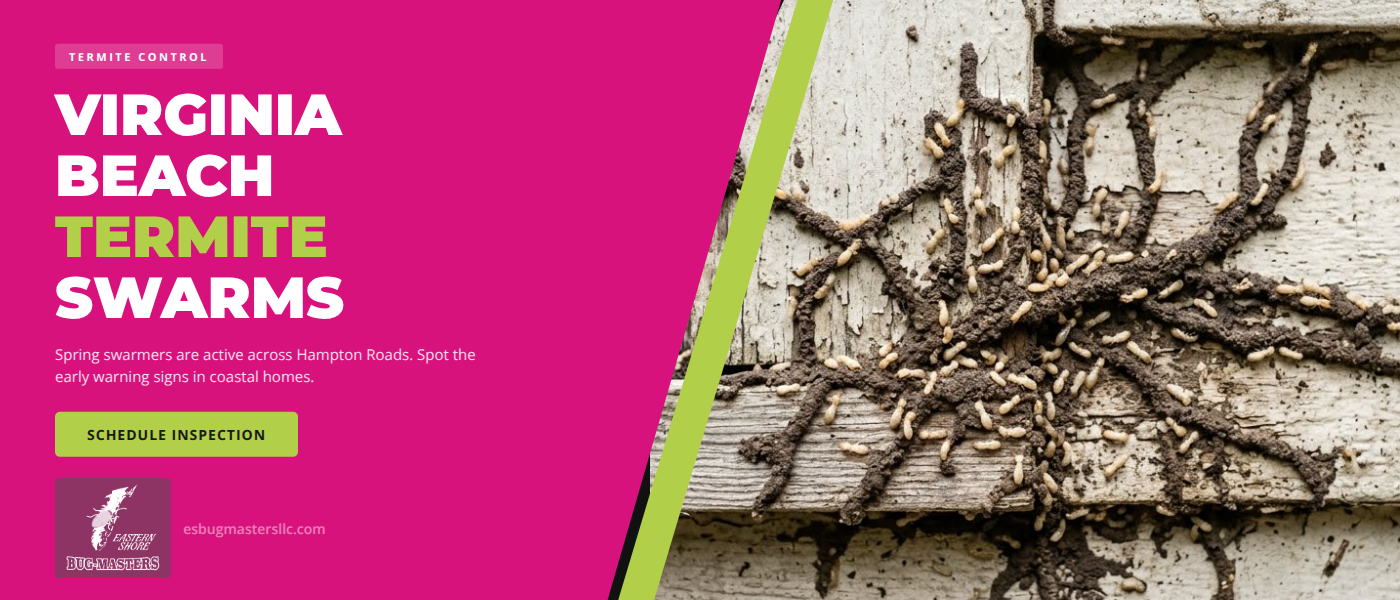
Termite mud tubes look like pencil-thin, dirt-colored tunnels — about a quarter-inch wide — running vertically up foundation walls, pier blocks, crawlspace joists, brick siding, or interior basement walls. They feel slightly gritty and crumble easily when scraped. Even a tube that appears empty or broken is evidence of subterranean termite activity and should be inspected, not removed.
No. They are often flying ants, midges, or other harmless seasonal insects. The clearest tells for termite swarmers are a uniform body with no pinched waist, straight beaded antennae, four wings of equal length, and small piles of shed wings left behind within a few hours.
Structural damage in load-bearing framing typically develops over three to eight years of unchecked activity, but cosmetic damage to trim, sills, and crawlspace sheathing can appear within a year or two. The math favors early detection.
In nearly all cases, no. Standard homeowners policies treat termite damage as a preventable maintenance issue, not a covered peril. That makes annual inspections and prompt treatment the practical financial protection for Virginia Beach homeowners — not insurance.