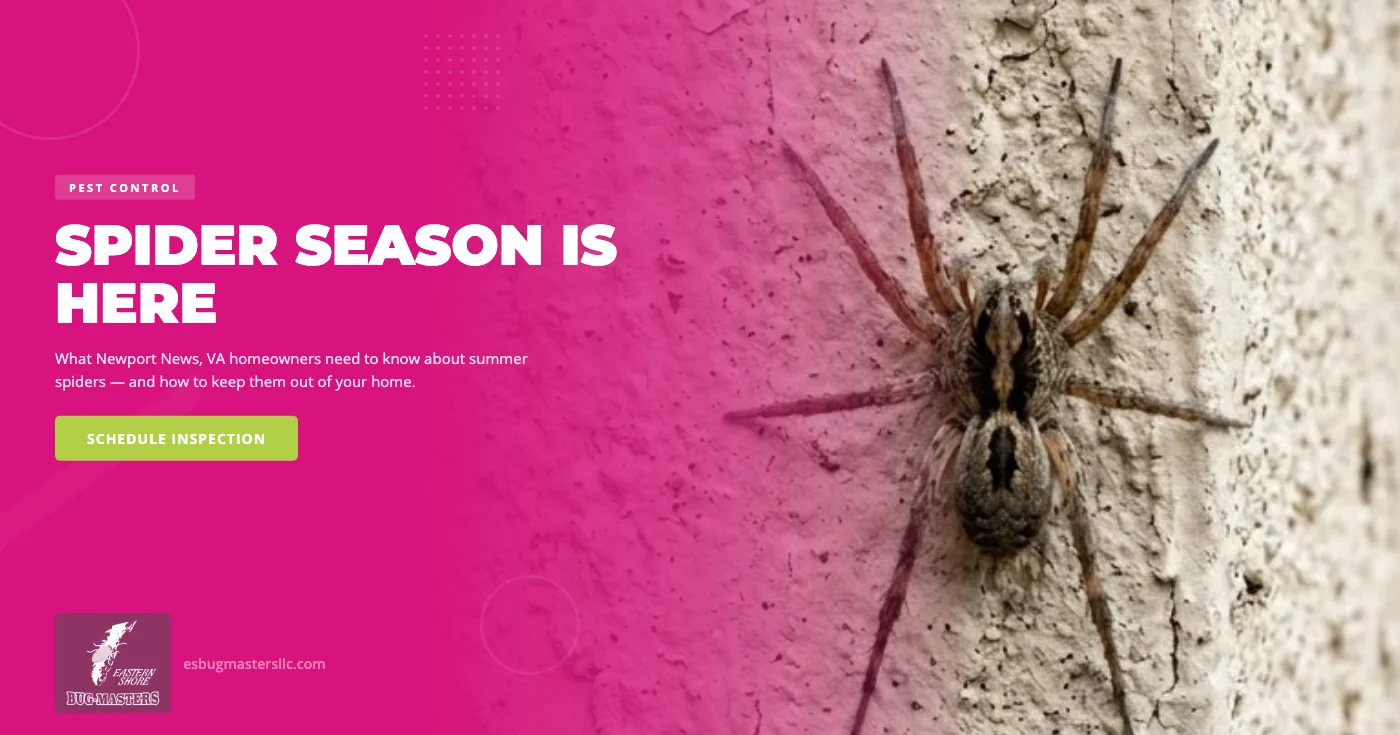
Newport News summers bring heat, humidity, and the return of every crawling thing that spent the cooler months tucked into cracks and crawl spaces. At Eastern Shore Bug Masters, our spider calls climb sharply from late June through September — a Newport News homeowner opens the shed, pulls back a garage curtain, or reaches into a basement corner and comes face-to-face with a spider they never noticed before. This guide covers why summer is prime spider season across coastal Virginia, the species we see most, what attracts them, and the practical steps that keep them out.
Spider activity in Newport News is driven by two things: temperature and prey. Coastal Virginia summers deliver both. Daytime highs sit in the mid to upper 80s from June through August, overnight lows rarely drop below 70, and humidity often stays above 70% for weeks. Those conditions accelerate the life cycles of the insects spiders feed on — ants, mosquitoes, flies, silverfish, gnats, and moths — which supports larger, more active spider populations.
Spring is when spiderlings hatch and disperse. By late June and July, those spiderlings have matured into visible, web-building adults. August and September bring peak breeding activity, when large webs appear across porch corners, garden gates, and shed doorways, and adult spiders wander indoors looking for mates or fresh hunting territory.
Peninsula geography adds another factor. Newport News homes bordered by wooded lots, tidal creeks, or the reservoir edge get elevated spider pressure from surrounding habitat. Older neighborhoods with mature landscaping, brick foundations, and crawl spaces provide the concealed daytime shelter spiders prefer.
The spiders we identify most often in Newport News homes fall into two categories: harmless species that occasionally wander indoors and stay out of the way, and a small handful of species that warrant a closer look. Knowing the difference cuts down on unnecessary panic and points to the right response.
One species worth clearing up: the brown recluse. Brown recluses are not native to Virginia. Virginia Cooperative Extension notes that documented populations exist only in isolated, introduced locations across the state, typically arriving through transported goods or firewood. The vast majority of "brown recluse" bites reported in Newport News turn out to be yellow sac or wolf spider bites — not a recluse.
Spiders don't move into a house looking for people. They move in because the property offers what spiders need most: prey, shelter, and moisture. Managing those three factors is the foundation of every prevention plan we build for Newport News homeowners.
Prey insects. Any home with a mosquito, ant, silverfish, gnat, moth, or fly population is an attractive hunting ground. When a Newport News property has heavy insect pressure — often from surrounding vegetation, standing water, or interior moisture — spider populations follow. Reducing the insect base reduces the spider base.
Outdoor lighting. Porch lights, garage lights, and landscape lighting draw moths, flies, and other flying insects. The clusters of insects at those lights become the buffet lines that build spider webs on eaves, doorways, and porch corners. Warm-color LED bulbs (2700K or lower) attract far fewer insects than older bright-white bulbs, and turning porch lights off when they aren't needed makes a noticeable difference within a few weeks.
Clutter and undisturbed spaces. Spiders prefer areas that stay quiet. Basements, crawl spaces, garages, attics, sheds, and unused rooms are prime harborage. Cardboard boxes, stacked lumber, tarp piles, and firewood piled against the foundation all create ideal shelter.
Moisture. The humidity levels in coastal Virginia already favor spider survival, but standing water, leaking pipes, damp basements, poorly ventilated crawl spaces, and clogged gutters make the problem worse. Moisture supports both the spiders and the insects they eat.
Cracks and gaps. Spiders enter homes through openings around doors, windows, utility lines, and foundation cracks. In older Newport News homes with brick foundations and original window frames, the number of gaps large enough for a spider to slip through can be significant.
Prevention works best as a layered plan. No single change eliminates spiders, but a handful of consistent habits meaningfully reduces the population that ever makes it into the home.
Most Newport News homes have some spider activity — a few garage webs, an occasional wolf spider in the basement — and don't need professional treatment. Some signs, though, mean the population has grown past what DIY measures can keep up with.
When any of these signs appear, our emergency pest control service handles the urgent cases — a confirmed black widow, a heavy indoor infestation, or spiders appearing in bedrooms and children's rooms — with priority scheduling.
Spider control in Newport News is most effective when it's built around the whole picture — the surrounding vegetation, the insect prey base, the home's construction, the species involved, and the season. At Eastern Shore Bug Masters, we design each spider control plan around the specific Newport News property rather than applying the same approach everywhere. A brick colonial in Hilton Village with a damp crawl space needs a different plan than a newer home in Kiln Creek with a heavy porch-web population.
Our program addresses spiders alongside the ants, mosquitoes, silverfish, and other insects they feed on — treating the underlying prey base rather than only the spiders themselves. For active infestations, we combine targeted interior treatment, exterior perimeter application, web removal, egg-sac elimination, and entry-point recommendations. Follow-up visits maintain the barrier through peak season.
Eastern Shore Bug Masters serves Newport News along with Hampton, Williamsburg, Norfolk, Portsmouth, Virginia Beach, Chesapeake, and Suffolk across Hampton Roads. If summer spider activity has moved past what regular sweeping can keep up with — or if a black widow, egg sacs, or repeated indoor sightings have you concerned — reach out and we'll take a look.
No. Brown recluses are not native to Virginia. Virginia Cooperative Extension documents only isolated, introduced populations across the state — nothing resembling an established local population in Newport News or the Hampton Roads region. Almost every "brown recluse" call we investigate turns out to be a yellow sac spider, a wolf spider, or another common species.
Don't try to handle or crush it. Photograph it from a distance if you can, keep children and pets away, and contact a professional. Black widows cluster in specific microhabitats — woodpiles, garage corners, under deck boards, around outdoor spigots — so one confirmed spider usually means the surrounding area needs inspection.
Spiders concentrate wherever prey, moisture, and shelter converge. Basements, crawl spaces, garages, and rooms adjacent to entry points typically see more activity than upstairs bedrooms. Areas near exterior lighting, damp corners, or clutter accumulate spiders faster than well-lit, dry, uncluttered spaces.
A single treatment reduces the population significantly, but coastal Virginia's summer conditions produce ongoing pressure from the outdoors. A recurring program that addresses spiders and their insect prey base through the active season delivers the most consistent control. Most Newport News properties benefit from a treatment schedule spanning the June-through-September peak.
Most spider bites in Newport News are mild and self-limiting — local redness, slight swelling, and no lasting effects. Yellow sac and wolf spider bites can produce more noticeable pain but rarely require medical care. Black widow bites are medically significant and warrant emergency evaluation. Any bite with spreading redness, fever, or systemic symptoms should be seen by a medical professional.