
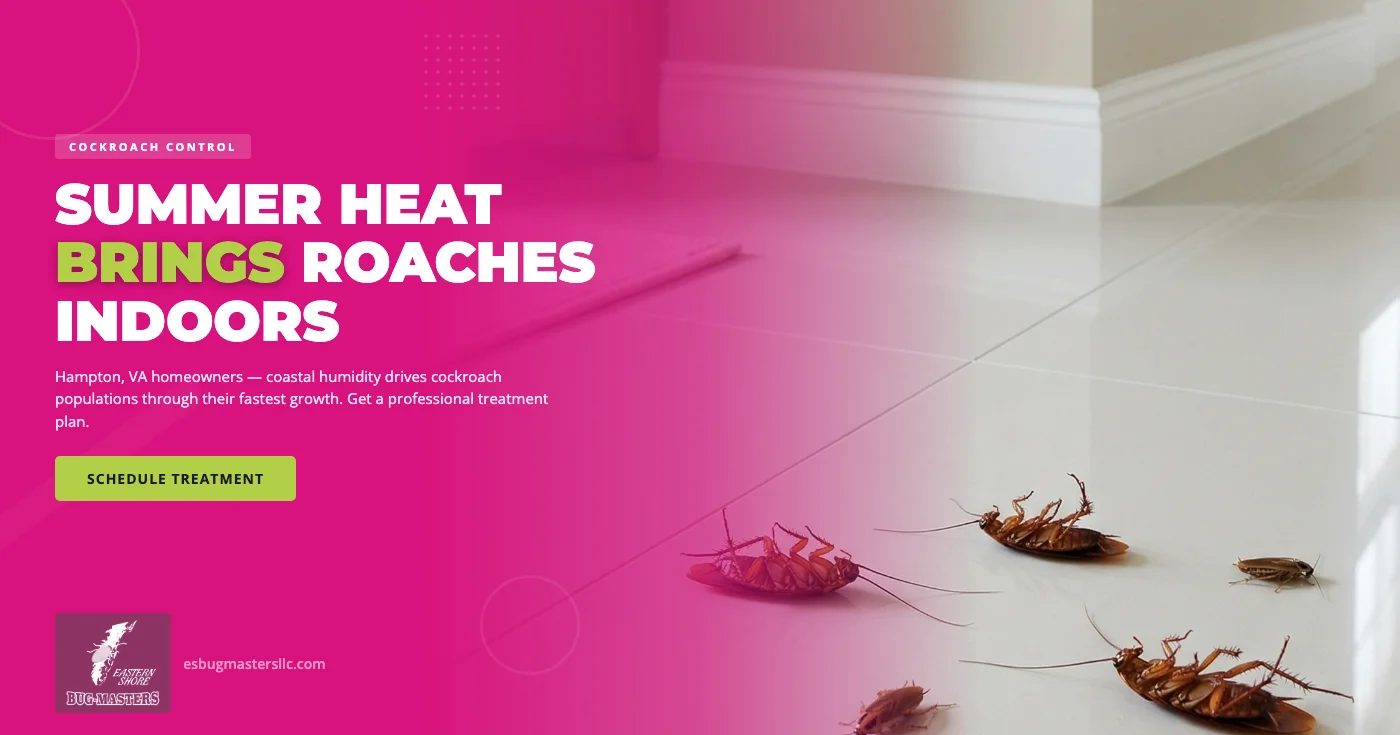
Anyone who has lived through a Hampton, VA summer knows the humidity is its own kind of weather — and the inside of every kitchen, bathroom, and crawl space across Hampton Roads is the exact climate cockroaches want most. At Eastern Shore Bug Masters, our calls about roach activity climb through June, peak in August, and stay heavy into October. This guide walks Hampton homeowners through why coastal Virginia summers drive the problem, the two species we see in nearly every infestation, where they hide, the early warning signs to catch at week one — and what real cockroach control in Hampton, VA looks like once an infestation is established.
Coastal Virginia gives cockroaches almost every condition they look for at the same time. Daytime highs in Hampton during July and August sit in the upper 80s, overnight lows rarely drop below 70, and relative humidity stays north of 70% for weeks. That combination speeds up cockroach metabolism and lets eggs hatch and nymphs mature faster than at any other point in the year.
Hampton's older waterfront homes, damp coastal soils under crawl spaces, sandy yards with high water tables, and storm drains that connect entire neighborhoods make for one of the most cockroach-friendly micro-climates on the East Coast. By the time most homeowners spot a roach on a kitchen floor at midnight, the population behind the wall has been growing for weeks.
When we run inspections in Hampton, the overwhelming majority of cockroach activity comes down to two species, and knowing which one you have changes the entire treatment approach.
Quick test: small, light brown, indoors, breeding — German. Big, reddish-brown, after a storm or near a basement floor drain — American. Different problem, different urgency, different treatment plan.
Cockroaches are nocturnal and extraordinarily good at finding gaps adults overlook. In Hampton homes, harborage points line up with the two species we see most.
American cockroach harborage: crawl spaces with damp earth or vapor-barrier gaps, around water heaters and laundry-room floor drains, basement utility rooms, garage corners with stored cardboard, mulch beds touching siding, storm drains and sewer access points, and woodpiles within ten feet of the home.
German cockroach harborage: inside dishwasher motor housings, the gap between the refrigerator and the cabinet, behind the toe-kick on lower cabinets, around hot-water plumbing inside the wall, under bathroom vanities, hinge wells of cabinet doors, the back of microwave clocks and coffee makers, and cardboard storage in pantries.
A German cockroach can fit through a gap one-sixteenth of an inch wide — about the thickness of a stacked dime. That's why a kitchen can look spotless and still hide a heavy population in voids no homeowner will ever inspect. When we run a follow-up, we use a flashlight along seams, hinges, and screw holes — not the open countertop — because that's where the colony actually lives.
The Hampton homeowners who catch a cockroach problem early almost always notice one of four signs before they ever see a live roach in good light:
When even one of these four signs shows up in a Hampton kitchen or bathroom, the timeline matters. A two-week delay during peak summer is often the difference between a single targeted visit and a multi-month plan.
We get calls every summer from Hampton homeowners who spent weeks fighting roaches with grocery-store sprays before reaching out. Those products often do short-term work but make the infestation harder to treat, not easier. Three reasons:
The bigger piece every store-bought product leaves out is sanitation, moisture, and exclusion. The U.S. EPA's guidance on cockroach control is direct: "Cockroach feces, skin sheddings and saliva can cause asthma and allergies, especially in children," and effective control requires removing food, water, and harborage rather than relying on chemicals alone.
A real cockroach treatment for either species follows the integrated pest management framework the EPA outlines in its introduction to IPM — inspect first, identify the species, address the conditions feeding the infestation, then apply targeted product where the population actually lives. A typical Hampton cockroach control visit from our team includes:
A heavy German cockroach infestation in a Hampton kitchen typically takes two to three visits over four to six weeks. An American cockroach problem driven by crawl-space or yard pressure often clears in one visit plus a follow-up. For sudden, heavy activity — daytime sightings throughout the home, or a population that surfaced overnight after a storm — our emergency pest control service prioritizes a same-week visit. Otherwise, our standard general pest control program covers cockroach treatment alongside the other species coastal Virginia homes deal with year-round.
A few thresholds where we'd encourage any Hampton homeowner to stop trying to handle a cockroach issue on their own:
Eastern Shore Bug Masters serves Hampton, Newport News, Norfolk, Virginia Beach, Chesapeake, Portsmouth, Suffolk, and Williamsburg with cockroach control, inspections, follow-up visits, and exclusion work tailored to coastal Virginia conditions. To schedule an inspection or ask about what you're seeing, reach out to our team and we'll have a technician on site as soon as your situation calls for it.
Why do I have cockroaches in my Hampton, VA home?
Climate, more than anything. Coastal Virginia humidity, warm overnight temperatures, and the moisture in older crawl spaces give both species what they need to breed quickly. Add a storm that floods outdoor harborage, a plumbing leak under a sink, or a pantry full of cardboard and crumbs, and the conditions are set. Cockroaches aren't a reflection of cleanliness — they're a reflection of climate, structure, and nearby food and water.
What attracts cockroaches indoors in summer?
Water, harborage, and food, in that order. Coastal humidity raises a cockroach's water needs, so any indoor moisture source — a dripping sink trap, AC condensate line, pet bowl, or refrigerator drip pan — becomes a magnet. Warm, dark crevices provide harborage. Crumbs, pet food, grease residue, and open pantry packaging supply the food. Heavy rain also pushes outdoor American cockroaches inside in waves, even when the home is well-maintained.
How can I tell if I have German cockroaches or American cockroaches?
Size and color. German cockroaches are about half an inch long, light tan to brown, with two dark parallel stripes down the back of the head — almost exclusively indoors in kitchens and bathrooms. American cockroaches are 1.5 to 2 inches, reddish-brown, and most often spotted in basements, crawl spaces, garages, and around floor drains. Americans come in from outdoor harborage; Germans almost always indicate an established indoor breeding population.
How long does cockroach control in Hampton, VA take to work?
For an American cockroach issue driven by outdoor pressure, most Hampton customers see activity drop within a week of the first treatment, with a follow-up confirming clearance two to four weeks later. For an established German cockroach population, expect four to six weeks across two to three visits — the timeline the biology actually requires.