If you have noticed more wasps drifting around the deck, workers slipping in and out of a hole in the yard, or a papery gray nest under the eave you swear was not there in July, you are watching the annual late-summer surge play out. This is when stinging insect colonies in Portsmouth, VA reach their largest size of the year — and when they turn from mostly indifferent neighbors into a real hazard around the home. If you are weighing whether to bring in professional stinging insect control in Portsmouth, VA before the first frost, the timing matters. Colonies do not slow down until a hard freeze, and that is usually still weeks away on the Hampton Roads coast.
Yellow jacket and paper wasp colonies start the season with a single overwintered queen and a handful of workers. Through spring and summer, the workers hunt insects to feed a growing brood of larvae, and the larvae, in return, produce a sugary secretion that feeds the adult workers. It is a protein-for-sugar trade that keeps the colony fed and calm.
In late August and September, that arrangement collapses. The queen stops laying, no new larvae are being raised, and the sugar supply the workers depended on dries up overnight. Meanwhile the worker population is at its yearly peak — a nest that housed a few hundred wasps in June can hold several thousand by mid-September, according to Virginia Cooperative Extension. Thousands of hungry adult wasps with no sugar coming home from the nursery turn into scavengers, and they get bold about it. That is why the yellow jacket on the picnic table in September is a very different animal from the one in June.
The second change is defensive. Colony-defense behavior escalates as the season closes, because losing the nest now means losing next year’s queens. Alarm pheromones released by a single stung or crushed worker recruit dozens of nestmates within seconds. Stinging insect control in Portsmouth, VA gets harder the later you wait for exactly this reason.
Not every buzzing yellow-and-black insect around your yard is the same threat. Correct identification changes the treatment, so this is where our team starts every inspection.
Eastern yellow jackets are the ones most Portsmouth homeowners run into. They nest underground in abandoned rodent burrows, under landscape timbers, and beneath decks or sheds. You will notice a steady stream of workers coming and going from a single hole in the lawn. They are the most aggressive of the local stinging insects and the ones behind most emergency calls this time of year.
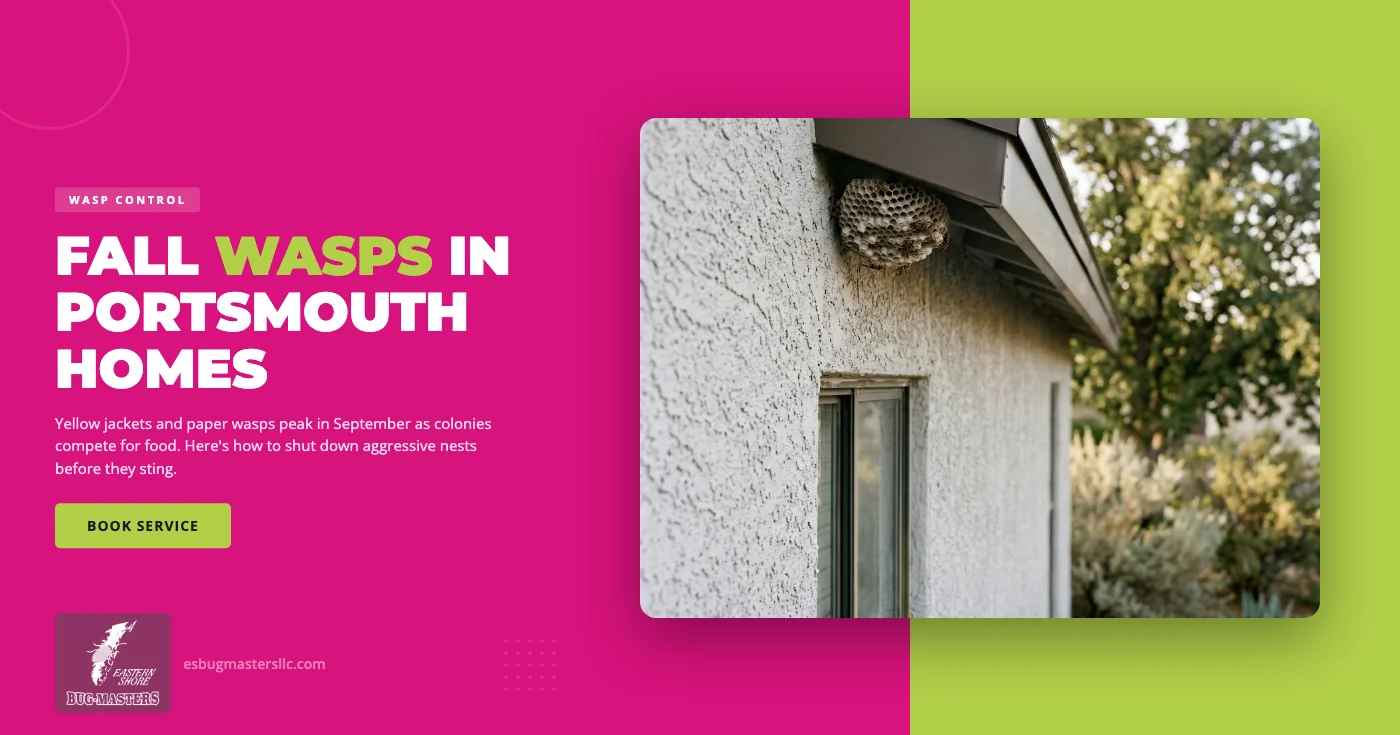
Paper wasps — both the native and the invasive European paper wasp common across the Hampton Roads region — build the open-comb umbrella-shaped nests under eaves, porch ceilings, mailbox posts, and inside grill covers. Their nests hold dozens of adults rather than thousands, but the workers still sting when disturbed.
Bald-faced hornets build the football-shaped gray paper nests that hang from tree branches and building corners. A mature nest can shelter several hundred workers, and they defend a wider zone around the nest than paper wasps do.
European hornets, larger and brown-and-yellow, nest in hollow trees, sheds, and wall voids. They are the only local stinging insect that regularly flies at night, so a wasp bumping the porch light after dark is usually this species.
Honeybees look superficially similar but are golden-brown and fuzzy rather than shiny yellow-and-black. Honeybee swarms and established hives are handled by a local beekeeper rather than a pest control company — we identify honeybees during the inspection and refer those cases out.
Stinging insects in coastal Virginia exploit the same handful of nesting sites over and over. Once you know the pattern, you can walk your own property and spot the risk before a full inspection.
Ground nests. Old rodent burrows, mulch beds along the foundation, gaps under stepping stones, spaces beneath railroad-tie retaining walls, and the loose soil around downspout splash blocks are all prime yellow jacket real estate. Look for a small hole with workers coming and going in a straight flight path.
Aerial nests on the house. Under eaves and soffits, inside gable vents, behind loose siding, in porch-ceiling corners, above outdoor lights, and inside little-used grills, playhouses, or planters. Any spot that is dry, wind-sheltered, and above head height is a candidate.
Voids and cavities. Wall voids behind soffit gaps, attic vents with damaged screens, and the framing around exterior electrical fixtures give yellow jackets and hornets an ideal enclosed cavity to build inside. These are the hardest nests to see from the ground and the most common reason for a wall-void call in October.
Yard structures. Sheds, detached garages, playsets, boat storage, and the underside of decks are all frequent finds in our Portsmouth inspections. Coastal humidity means these spaces hold moisture, which helps the wasps chew the wood fiber they use to build their nests.
Most homeowners find a stinging insect nest by accident — mowing over it, opening the grill, or reaching into the shed. A closer look at your yard in September can catch the nest before that first surprise sting.
Every year we see homeowners who tried a can of hardware-store wasp spray first and are now calling for stinging insect control in Portsmouth, VA with a hand or eye that got hit. The store-bought wasp-freeze can knock down a small, exposed paper wasp nest on a porch column if you catch it early in the season. In late summer with a mature colony, the math changes fast, and the risk is not theoretical.
Alarm pheromones recruit the whole colony. A single stung or squashed worker releases a chemical signal that pulls dozens more into the fight within seconds. A five-second spray at a ground nest can put a hundred workers in the air chasing you across the yard.
Plugging the entrance backfires. Homeowners commonly try to seal a hole in the siding after treating it. Virginia Cooperative Extension warns that trapped workers will chew a new opening — often into the living area of the house — rather than accept a plugged nest.
Gasoline, bleach, and fire are worse than the wasps. Pouring flammable liquids into a ground nest or lighting a torch under an eave has caused house fires, groundwater contamination, and severe injury. Extension services across the region actively discourage every one of these approaches.
Ladders and stings do not mix. A single defensive sting on a homeowner reaching up under a soffit is enough to knock them off a ladder. Falls from second-story eaves account for a real share of the emergency-room visits in stinging insect season.
Allergy risk climbs with colony size. Even a person with no history of a bee allergy can develop one after a heavy sting exposure. A ground nest kicked open by a lawnmower can deliver dozens of stings in seconds.
Professional stinging insect control in Portsmouth, VA is not just a stronger can of spray. It is a sequence built around the biology of the colony, and it starts before any product is applied.
Species identification and site survey. Yellow jackets, paper wasps, hornets, and honeybees all get treated differently — and honeybees do not get treated at all. We map every active flight line and locate the actual nest, not just the entry the homeowner spotted.
Timing the treatment to the colony. The most effective window is late evening or after dusk, when the vast majority of workers have returned to the nest. Daytime treatments leave the returning foragers alive and looking for a new place to build.
The right formulation for the nest type. Aerial paper nests get a residual liquid or aerosol applied to knock down defenders and coat the comb. Ground nests and wall-void colonies get an insecticidal dust puffed into the entrance, so returning workers carry it deep into the nest as they crawl through. Dust in a wall void is the standard because liquid treatment can drive surviving workers deeper into the structure.
Follow-up and monitoring. A colony treated correctly at dusk is usually inactive by the next morning, but we schedule a second visit to confirm no returning workers are rebuilding nearby and to seal likely re-entry points at your direction. Every professional will tell you the same thing: no responsible pest control company can promise a home stays wasp-free forever, because next year’s queens are already scouting overwintering sites. What we can promise is a documented, methodical removal of the colony you have right now.
Recurring service through the fall keeps the pressure off — new queens that find your soffit inviting in October do not get to found next spring’s colony under our watch.
Stinging insect activity peaks in Portsmouth, VA between mid-August and the first hard freeze, which around here usually lands sometime in November. Every week you wait, the colony grows, the defensive response gets sharper, and the risk of a surprise sting climbs. If you have seen any of the warning signs on your property — a flight line at a fence, a paper cone under the eave, dead wasps on a windowsill, or workers coming out of the siding — the next step is a professional inspection.
Our team handles the full range of stinging insect control in Portsmouth, VA, from a single paper wasp nest on the porch to a wall-void yellow jacket colony that needs a dust treatment inside the structure. We start with identification, treat at the right time of day, and follow up to confirm the colony is done. If you want a walk-through and an honest recommendation before the next warm afternoon brings more workers into the yard, learn more about our General Pest Control program or view the full list of All Pest Services we offer across the Hampton Roads area, then call to schedule a free inspection.