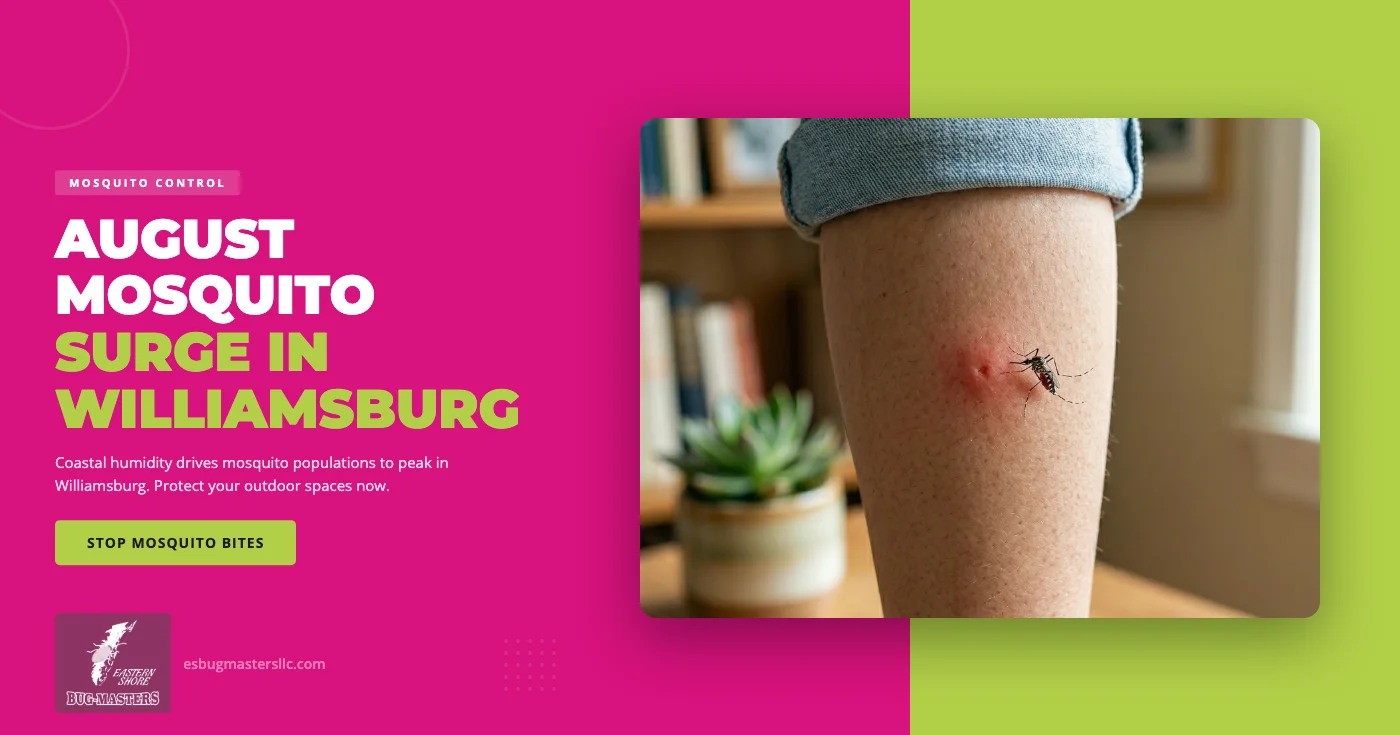
If you've spent any time on your porch or near the wooded edges of your yard in Williamsburg this month, you already know what the calendar confirms: August is the worst stretch of the year for mosquitoes. This isn't your imagination. Late-summer mosquito populations in Williamsburg, VA peak for very specific reasons — humidity, standing water, and generational overlap all working together. If you're weighing whether to invest in mosquito control in Williamsburg, VA this season, the timing matters more than most homeowners realize.
Mosquito activity in coastal Virginia follows a predictable arc. Populations start building in April as temperatures warm, ramp through June and July as breeding cycles compound, and hit their peak in August when generations that hatched earlier in the season are all active simultaneously. In Williamsburg specifically, August combines the hottest and most humid stretch of the year with the accumulated output of four to five months of continuous breeding.
What makes August feel dramatically worse than June or July is what entomologists call population overlap. Female mosquitoes that emerged in July are producing eggs while females from earlier hatches are still active. The result is a landscape saturated with biting mosquitoes at every life stage, from newly emerged adults to older mosquitoes actively seeking blood meals. Any brief dip in the population from a stretch of dry weather is offset within days by the next generation reaching adulthood.
Williamsburg's setting compounds the pressure. Historic properties, wooded lots, and proximity to the James and York River watersheds create a mosaic of habitats where different mosquito species thrive. Asian tiger mosquitoes, the common house mosquito, and floodwater species all overlap here — each with its own biting pattern and breeding preference. By August, all of them are working against you at once, which is why mosquito control in Williamsburg homes leans heaviest on prevention this time of year.
Heat and humidity aren't just uncomfortable for people — they're accelerants for mosquito reproduction. Every stage of the mosquito life cycle, from egg to larva to pupa to adult, moves faster when temperatures rise. In Williamsburg's August climate, the full life cycle can compress from around fourteen days in cooler weather down to just five to seven days. That means a single female laying eggs in a puddle behind your shed today can produce dozens of biting adults before the following weekend.
Humidity plays a second, less obvious role. Adult mosquitoes lose body moisture quickly in dry air, which limits how far they can fly and how long they can survive between blood meals. In the humid air that sits over the Middle Peninsula and Virginia Peninsula through August, mosquitoes can travel farther from breeding sites and live longer as adults, which extends their window to bite and to reproduce.
According to the CDC, controlling mosquitoes around the home requires a combined approach that targets both adult mosquitoes and the standing water where larvae develop. The agency emphasizes that eliminating breeding habitats is the single most effective step homeowners can take, because reducing the number of larvae that reach adulthood directly reduces biting pressure a week later.
Mosquitoes need remarkably little water to breed. A bottle cap's worth is enough to support a full generation. That reality is what makes Williamsburg yards so productive for mosquitoes in late summer — small pockets of water hide in more places than most homeowners think to check. When we inspect properties across the Williamsburg area, these are the breeding sites we find most often:
Most Williamsburg properties have three or four of these breeding sites active at once in August. Finding and eliminating them is the foundation of any effective reduction plan.
You can meaningfully reduce mosquito pressure on your property with a consistent DIY routine. These steps won't eliminate every biting mosquito in the neighborhood — flying adults travel from surrounding properties and public spaces — but they will reduce the population breeding on your own land, which is often the most productive source of bites:
Consistency matters more than intensity here. Following the routine every week from now through October will significantly reduce breeding pressure. Skipping weeks — especially after heavy rain — undoes much of the progress.
DIY steps handle a lot of the breeding on your own land, but they have limits. The mosquitoes flying in from adjacent wooded areas, drainage ditches, standing water on neighboring properties, and larger public spaces are outside your reach. When home-based prevention isn't producing meaningful relief, professional treatment addresses what you can't reach on your own.
Here are the situations that consistently indicate it's time to bring in a licensed provider:
Professional mosquito control uses residual treatments in resting habitat combined with larvicide in identified breeding areas. This addresses both the mosquitoes biting today and the next generation that would otherwise emerge a week from now — a combined approach no consumer product can match for scope or duration.
Our approach to mosquito control in Williamsburg starts with a thorough inspection of your property. We walk the entire perimeter, identify active and potential breeding sites, note the resting habitat where adult mosquitoes shelter during the day, and assess the surrounding pressure from neighboring properties and natural features. Every treatment plan we recommend is built around what we actually find, not a one-size-fits-all package.
For active infestations, we apply a residual barrier treatment to the shaded, humid vegetation where adult mosquitoes rest — the underside of leaves in shrubs, dense ground cover, and shaded fence rows. This treatment reduces the adult population immediately and continues working for several weeks as mosquitoes contact treated surfaces. We combine that with targeted larvicide applications in any standing water we identify that can't be drained.
Ongoing prevention is where we make the biggest difference for Williamsburg homeowners. Recurring treatments through the peak season keep the resting habitat protected and stop new generations from establishing on your property. Our Mosquito Control service is structured around this recurring model because one-time treatments simply can't hold up against Williamsburg's late-summer breeding pressure.
We also want to be straightforward: no responsible pest control company can promise your yard will be 100 percent free of mosquitoes. Adults fly in from surrounding areas, and our climate produces continuous breeding pressure. What we can deliver is a dramatic, measurable reduction in biting activity and the peace of mind that comes from knowing your property is being actively protected. For homeowners dealing with multiple pest pressures at once, our General Pest Control programs pair naturally with recurring mosquito treatment for full-season coverage.
August peaks are real, but Williamsburg's mosquito season extends well into October in most years. Warm, humid stretches in September and early October regularly produce late-season surges that catch homeowners off guard when they think the worst is behind them. The Virginia Cooperative Extension recommends maintaining prevention efforts through the first hard frost, because breeding continues as long as temperatures stay warm enough for larvae to develop.
Planning ahead means treating late August and September as one continuous stretch rather than assuming activity will drop off after Labor Day. Keep up with weekly water tipping, maintain your landscaping schedule, and consider extending professional treatments through October if you spend significant time outdoors. Football tailgates, evening firepit gatherings, and outdoor dinners all fall squarely within the extended biting season here.
For homeowners who want lasting relief without the constant vigilance, ongoing mosquito control in Williamsburg, VA delivers the most consistent protection through peak season and beyond. We handle the inspections, the treatments, and the timing so you can focus on actually enjoying your yard.
If August has pushed your patience past its limit and you're ready to reclaim your outdoor spaces, contact us today to schedule a Williamsburg mosquito inspection. We'll walk your property, identify what's driving the activity, and build a plan that fits how you actually use your yard.