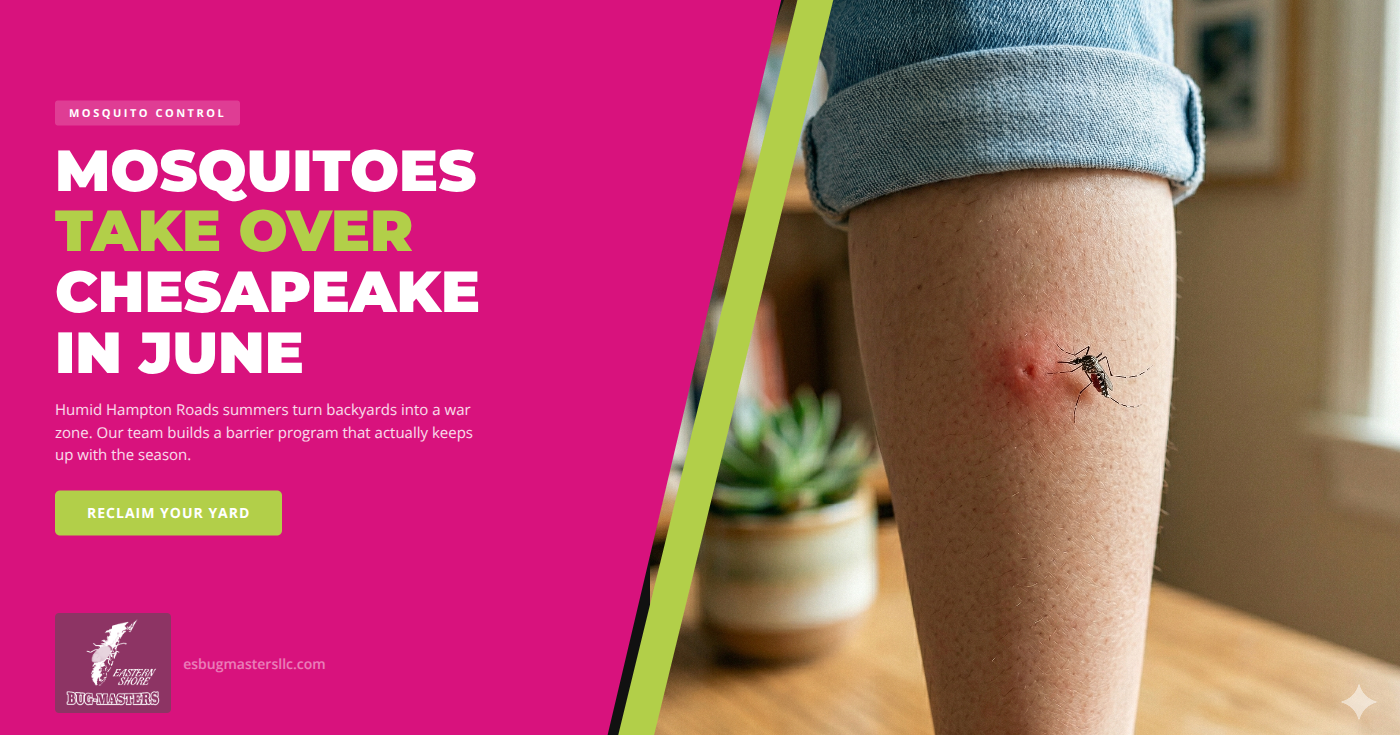
It happens every year. Memorial Day weekend feels like the start of summer, and by mid-June you cannot sit on the back porch for ten minutes without slapping. If you have started searching for mosquito control in Chesapeake, VA, you already know this is not your imagination — our region turns into one of the worst mosquito zones on the East Coast the moment summer humidity sets in.
At Eastern Shore Bug Masters, we have spent years treating Chesapeake yards, and the same patterns show up every June: standing water no one noticed, dense landscaping that holds moisture, and species that bite at every time of day. The good news is that mosquito populations are manageable when you understand what is driving them — and what actually pushes them back. This guide covers why our area is such a hotspot, the species you are really facing, the hidden backyard culprits, the health risks worth knowing about, and how professional mosquito control compares to do-it-yourself fixes.
Chesapeake sits at one of the most mosquito-friendly addresses in the country. The city wraps around branches of the Elizabeth River, the Northwest River, and the northern edge of the Great Dismal Swamp, with hundreds of canals, ditches, and tidal wetlands threading through neighborhoods. Every one of those features is a potential breeding ground.
The climate adds the second half of the problem. Late spring rainfall in Hampton Roads sits in our heavy clay soils and slow-draining yards. June brings consistent humidity above 70 percent, daytime highs in the 80s, and the warm overnight lows mosquitoes need to keep reproducing. Most species in our area can go from egg to biting adult in five to seven days when conditions are right — and in June, conditions get very, very right.
The result is a population explosion. A yard that felt fine on Memorial Day can become unusable by the third week of June, and by July, evening cookouts often require fans, candles, and luck. Effective mosquito control in Chesapeake, VA has to account for both the standing water on your property and the constant new arrivals from neighboring wetlands.
Not every mosquito behaves the same way, and a treatment program that ignores species ends up missing the worst offenders. Across our region, three groups cause most of the trouble.
The Asian tiger mosquito (Aedes albopictus) is the daytime biter you can blame for ruining your afternoon. It is small, fast, marked with sharp white-and-black stripes, and it prefers shaded, humid, planting-heavy parts of a yard. It does not need a pond to breed — a bottle cap of water under a flowerpot is enough.
The southern house mosquito (Culex quinquefasciatus) is the one that ruins evenings. It feeds at dusk and after dark, breeds in stagnant water like clogged gutters and birdbaths, and is the primary carrier of West Nile virus in our region.
Then there are the floodwater species, which lay eggs in low spots that dry out and refill — the kind of areas any Hampton Roads homeowner has after a heavy thunderstorm. When a tropical system rolls through in late summer, populations of these species can explode within a week.
Knowing which species is biting helps us choose the right product, the right placement, and the right cycle for treatment.
Most homeowners assume the mosquitoes are coming from the woods, the marsh, or the neighbor's overgrown yard. Sometimes that is true. More often, the worst breeding source is somewhere on your own property — and it is something you walk past every day.
The most common culprits we find on local yards include:
According to the Centers for Disease Control and Prevention, mosquitoes can lay eggs in as little as a bottle cap of water and go from egg to adult in as little as five days. Walking your yard once a week and dumping anything that holds water can cut backyard mosquito pressure dramatically.
Mosquito bites in our area are not just an itchy nuisance. Several mosquito-borne illnesses are tracked in Virginia every summer, and Hampton Roads tends to see higher pressure than the rest of the state.
West Nile virus is the most common mosquito-transmitted illness in Virginia. According to the Virginia Department of Health, most cases are linked to Culex mosquitoes — the same southern house mosquitoes that take over Chesapeake backyards at dusk. Most infected people never feel sick, but a small percentage develop serious neurological illness.
Eastern Equine Encephalitis (EEE) is rare but ranks among the most serious mosquito-borne diseases in the United States. Cases are uncommon in Virginia, but the species capable of transmitting EEE do live in the swamp and wetland areas at our southern edge.
Pets are exposed, too — heartworm is transmitted by mosquito bite, which is why veterinarians across Hampton Roads recommend year-round prevention. Reducing the mosquito population around your home protects your family, your pets, and your guests at the same time. The Virginia Department of Health updates its mosquito-borne disease tracking weekly through the summer, and we keep an eye on those reports so we know when local pressure is climbing earlier or harder than usual.
Smart mosquito control starts with what you can do yourself. Plenty of homeowner steps make a real difference, and we recommend them to every customer:
The limits show up quickly. Bug zappers and citronella candles do almost nothing against a steady mosquito population. Store-bought hose-end sprays kill mosquitoes for a day or two, then break down in the sun. Ultrasonic devices have no measurable effect at all. And no homeowner routine can offset constant new arrivals from a neighboring wetland, drainage ditch, or wooded lot — which, in our part of Virginia, is most properties.
That is the gap professional treatment is built to fill. Our work is not a replacement for the basics — it is a layered shield that handles the part of the population you cannot reach on your own. The homeowners who get the best results are the ones who keep up with weekly source reduction and let our team handle the residual barrier, larvicide, and timing.
When our team handles mosquito control in Chesapeake, VA, the visit is more than a quick spray. A typical service includes:
Every treatment uses products labeled for residential use and applied by trained Eastern Shore Bug Masters technicians who work with care around children, pets, and pollinator plants. Our team also flags non-mosquito issues during the visit, so we can recommend follow-up service if ants, termites, or rodent activity show up on the property.
The single most common mistake we see is waiting until the mosquitoes are already unbearable. Mosquito control works best when it gets ahead of the population — by the time bites are nightly, the population has been compounding for weeks, and the first treatment has to play catch-up.
Our recommended timeline for a typical yard in our service area:
If you are already past that ideal window, do not write off the rest of summer. We start mid-season programs constantly, and the difference after the second treatment is almost always dramatic. The fall treatment is the one homeowners skip most often and the one that makes the biggest difference the following spring — fewer overwintering females means a much slower buildup come April.
We also handle termite treatment and rodent control for homeowners across the Eastern Shore and the broader Hampton Roads region — so a single annual visit can address mosquitoes alongside the rest of your property's pest pressure.
A barrier treatment typically protects your yard for two to three weeks before the residual product breaks down. That is why we recommend a recurring three-week schedule through peak summer — it keeps the population suppressed instead of letting it rebuild between visits.
We use products labeled for residential properties and apply them following EPA guidance. We ask families to keep children and pets indoors during application and until treated foliage is dry, typically 20 to 30 minutes. After that, the yard is ready to use again.
We avoid spraying flowering plants in bloom, treat early morning or late evening when pollinators are least active, and focus applications on mosquito resting areas rather than open flower beds. Eliminating standing water reduces breeding without affecting beneficial insects at all.
In Hampton Roads, the first mosquitoes usually show up in April, populations climb through May, and peak biting pressure runs from June through September. A few species stay active into early November in mild years. The exact timing shifts a few weeks each year based on spring rainfall and how warm the overnight lows stay, so we adjust our service schedule to match what the season is actually doing.
Mosquitoes will always be part of life in Chesapeake — the geography guarantees it. But "always present" is very different from "you cannot use your yard." With weekly source reduction and a professional mosquito control program built for Chesapeake, summer evenings in Hampton Roads do not have to be a tradeoff.
Eastern Shore Bug Masters has served homeowners across Hampton Roads — including Chesapeake, Virginia Beach, Norfolk, Suffolk, and the Eastern Shore — with locally informed pest treatment for years. If June is already off to a rough start, or you want to set up a recurring program before next season, we are ready to help. Get in touch with our team to schedule an inspection of your property.