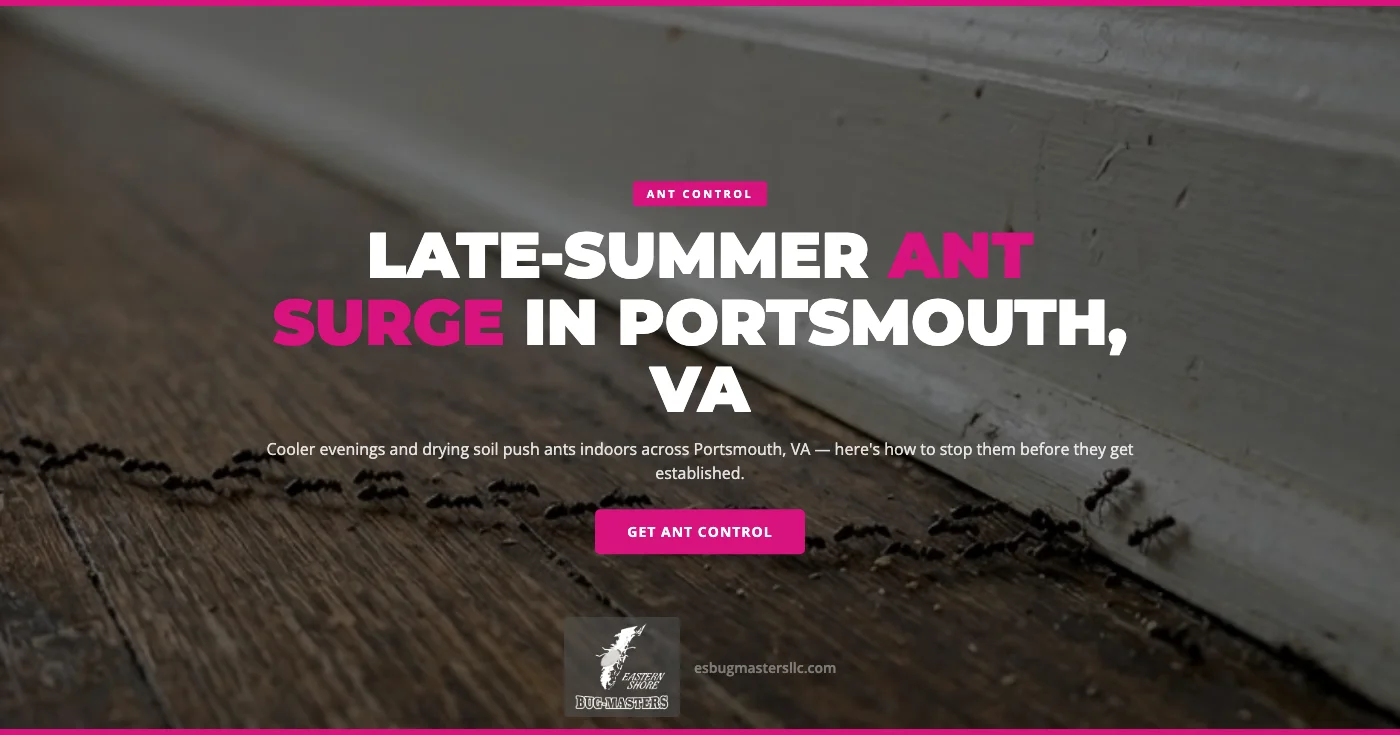
If you've noticed ant trails across your kitchen counters or along baseboards over the past few weeks, you're not imagining it. Late summer is peak indoor ant season in Portsmouth, VA — the same heat, humidity, and dry stretches that make August miserable for people push ant colonies to expand their foraging into homes. Effective ant control in Portsmouth, VA starts with understanding what's driving the activity and taking the right prevention steps before ants establish trails that are difficult to break.
Why Ants Are More Active in Late Summer in Portsmouth, VA
Ant behavior in August responds directly to environmental pressure — and Portsmouth's late summer climate creates several pressures at once. Colonies that have been expanding all spring and early summer reach peak worker population in August, meaning more foragers are actively scouting for food and water than at any other time of year.
Heat and drought conditions accelerate that pressure. When outdoor moisture sources dry up between storms, ants travel farther from the colony to find water. The consistent moisture inside a home — leaky pipes under sinks, condensation around HVAC lines, pet water bowls, damp bathroom floors — becomes irresistible. According to the Virginia Tech Insect Identification Lab, moisture is one of the primary attractants driving indoor ant activity, and homes with unresolved moisture issues become natural targets during hot, dry weeks.
Portsmouth's coastal environment adds another layer. The city sits along the Elizabeth River and shares Hampton Roads' high summer humidity, which supports larger, more active colonies than drier inland regions can. When afternoon storms push humidity higher, ants ramp up foraging in cooler morning and evening hours — the exact times homeowners notice fresh trails along counters and baseboards.
Common Ant Species Found in Portsmouth Homes
Not every ant trail in a Portsmouth kitchen means the same thing. Different species nest differently, prefer different foods, and need different treatment — which is why professional ant control in Portsmouth, VA begins with correct species identification, not blanket spraying. These are the species we see most often:
- Odorous house ants — Small, dark brown to black ants that emit a rotten-coconut smell when crushed. They form multi-queen colonies that relocate quickly when disturbed, which is why over-the-counter sprays often make the problem worse. One of the most common indoor nuisance ants across Portsmouth, especially in kitchens where sweet foods are accessible.
- Pavement ants — Small brown-black ants that nest under sidewalks, driveways, slabs, and along foundation edges. They enter through cracks in slab foundations and expansion joints. Because their nests sit directly against or under the structure, surface treatment alone rarely addresses the source.
- Carpenter ants — Significantly larger than nuisance species, reddish-brown to black. They don't eat wood — they excavate it to build satellite nests, preferring wood already softened by moisture damage. In Portsmouth's humid coastal environment, water-damaged framing around windows, roofs, and bathrooms gives carpenter ants plenty of appealing nesting sites.
- Little black ants — Very small, uniformly black ants often seen in long trails across counters and floors. They nest in wall voids, behind cabinets, and in exterior masonry, and their size lets them exploit entry gaps larger species can't fit through.
- Argentine ants — Light to medium brown ants that form massive interconnected super-colonies with many queens. Populations don't respect nest boundaries, meaning one problem property in a neighborhood can seed activity in nearby homes.
Species identification matters because the treatment strategy changes accordingly. Odorous house ants respond to non-repellent baits carried back to multiple queens; carpenter ants require locating and treating the actual nest, often buried in a wall void or ceiling; pavement ant treatment centers on the exterior perimeter. A one-size-fits-all approach is why some homeowners cycle through spray cans all summer without ever eliminating the problem.
Entry Points Ants Use to Get Indoors
A gap the width of a credit card is enough for a worker to enter, and once a scout finds a food or water source, it lays a pheromone trail that guides the rest of the colony back along the same path. These are the entry points we inspect most often in Portsmouth homes:
- Foundation cracks and expansion joints — Slab foundations in Portsmouth homes develop hairline cracks from settling and soil movement, and pavement ants and odorous house ants exploit them directly. Cracks along the sill plate where the foundation meets the framing are especially common access routes.
- Gaps around plumbing and electrical penetrations — Every pipe and wire entering your home passes through a hole in an exterior wall or slab. When the original caulking has shrunk, cracked, or been removed during a repair, that penetration becomes an ant highway.
- Weatherstripping and door thresholds — Worn weatherstripping around exterior doors, garage doors, and sliding patio doors creates a continuous gap along the door base. Ants trail directly across the threshold into interior floor space.
- Window frames and screens — Deteriorated caulking around window frames, gaps in screen mesh, and unsealed edges where windows meet siding are common entry routes, especially for smaller species like little black ants.
- Vegetation and mulch in direct contact with the foundation — Shrubs, tree branches, and mulch beds touching the exterior wall act as bridges from ground-level colonies straight to structural framing. Mulch pushed against the foundation is one of the most common entry-enabling conditions we find in Portsmouth landscaping.
- Weep holes and vent openings — Brick veneer weep holes, dryer vents, soffit vents, and crawl space vents provide direct access to wall voids and interior spaces. They shouldn't be sealed shut, but they need appropriate screening to keep insects out.
A thorough entry-point audit is the first step in any prevention strategy. Sealing food sources indoors accomplishes nothing if ants have a dozen open pathways to come find them.
DIY Ant Prevention Steps That Actually Work
Not every DIY step delivers real results. Here's what actually reduces indoor ant activity for Portsmouth homeowners:
- Seal foundation cracks and utility penetrations — Use exterior-grade silicone caulk or polyurethane sealant on visible cracks along the foundation, around pipe and wire penetrations, and where siding meets foundation. This is the single most effective structural step for reducing indoor ant activity.
- Trim vegetation back from the house — Cut shrubs and tree branches so nothing directly touches the siding or roof. Aim for at least 18 inches of clearance, and pull mulch back from direct foundation contact.
- Address indoor moisture aggressively — Fix leaking pipes, dripping faucets, and sweating HVAC lines. Check under sinks for slow leaks that keep the cabinet floor damp. Dry conditions are one of the strongest anti-ant setups you can create during a Portsmouth summer.
- Store food in airtight containers — Sugar, flour, cereal, and pet food should be sealed in glass or hard plastic rather than left in original packaging. Pay particular attention to sweet products — odorous house ants and little black ants are strongly attracted to sugar.
- Clean up crumbs and spills immediately — A sticky spill under a toaster or dropped cereal behind an appliance is enough to establish a foraging trail. Wipe counters after every meal, sweep under appliances weekly, and take out kitchen trash before it accumulates.
- Use bait, not spray — When you find an ant trail, resist the urge to spray it. Sprays kill visible workers but do nothing to the colony, and they trigger multi-queen species like odorous house ants to split and relocate — often creating more indoor colonies than you started with. Slow-acting baits workers carry back to the nest are more effective at eliminating the source.
- Empty pet water bowls overnight — Standing pet water is a primary moisture attractant. Empty and refresh bowls each night, especially during dry weeks.
Consistent execution of these steps genuinely reduces indoor ant pressure. What DIY prevention doesn't do is eliminate an established indoor colony or address species that require targeted treatment.
When DIY Is Not Enough: Signs You Need Professional Ant Control
There's a difference between an occasional scout ant appearing after heavy rain and an active indoor infestation. These are the signals we use to distinguish the two — any one warrants professional evaluation:
- Persistent trails that return within days of cleaning — If you wipe down a trail, seal apparent entry points, and the same trail reappears within 48 to 72 hours, workers are reaching a food or water source DIY treatment isn't disrupting. A nest is usually closer than you think.
- Ant activity in multiple rooms simultaneously — Isolated kitchen activity is common; simultaneous activity in the kitchen, bathroom, and basement suggests either a large single colony with multiple foraging trails or multiple satellite colonies. Both require professional treatment.
- Sawdust-like material near wooden structures — Small piles of fine debris near baseboards, window sills, or beam undersides indicate carpenter ant excavation. This is a structural problem, not a nuisance one, and needs immediate attention before damage compounds.
- Winged ants indoors — Winged reproductive ants inside the home indicate a mature colony has established itself indoors — mature enough to produce reproductives. Particularly for carpenter ants, this signals a satellite nest inside the structure.
- Ants emerging from electrical outlets, light fixtures, or wall voids — Ants exiting through interior openings that aren't near exterior walls indicate the nest is inside the structure itself. Structural nests require targeted treatment to eliminate.
- Recurring seasonal infestations in the same location — If ants appear in the same spot each summer despite repeated DIY treatment, the underlying conditions haven't been resolved. Professional inspection can identify the persistent driver — hidden moisture, a structural gap, or an established exterior nest — that keeps drawing new activity.
Any of these patterns means the DIY-only approach has hit its limit. Professional ant control in Portsmouth, VA is what closes the gap between managing symptoms and eliminating the source.
How Eastern Shore Bug Masters Eliminates Ant Infestations in Portsmouth
Eastern Shore Bug Masters approaches ant control in Portsmouth, VA the way any pest problem should be handled — starting with inspection, not application. Every home begins with species identification and site assessment. We walk the exterior perimeter to locate activity and access points, inspect crawl spaces and interior at-risk zones, and identify the specific species before recommending a treatment plan.
Treatment strategy follows from what the inspection reveals. Odorous house ants and other multi-queen species get targeted baiting programs that workers carry back through the colony, addressing all queens rather than fracturing the colony into new satellites. Carpenter ant infestations require locating the actual nest — often in a moisture-damaged wall void, roof line, or window frame — and treating it directly while addressing the underlying moisture condition. Pavement ant treatment centers on the exterior foundation edge and expansion joints where the colonies are actually nesting.
Ongoing prevention matters as much as initial treatment. Portsmouth's coastal environment and year-round warmth mean ant pressure is constant — colonies removed from a property are replaced by new activity within months if the structural and environmental conditions haven't been addressed. That's why our General Pest Control programs are structured for recurring service that keeps exterior populations suppressed and identifies new activity before it becomes an indoor infestation.
We serve homeowners across Portsmouth and the greater Hampton Roads and Eastern Shore region. Our technicians know the construction patterns typical of Portsmouth homes, the moisture dynamics of coastal Virginia, and the ant species most likely to be present. When we recommend a treatment, we explain what we've found and why — no pressure, no cookie-cutter approach.
If you've noticed persistent trails, activity in multiple rooms, sawdust near wooden framing, or ants appearing from indoor wall voids, late summer is the right time to have the situation professionally evaluated. Colonies are at peak activity now, which means treatment carries most effectively through the colony — every week of delay is more time for the population to expand indoors. Contact Eastern Shore Bug Masters today to schedule your Portsmouth ant inspection.