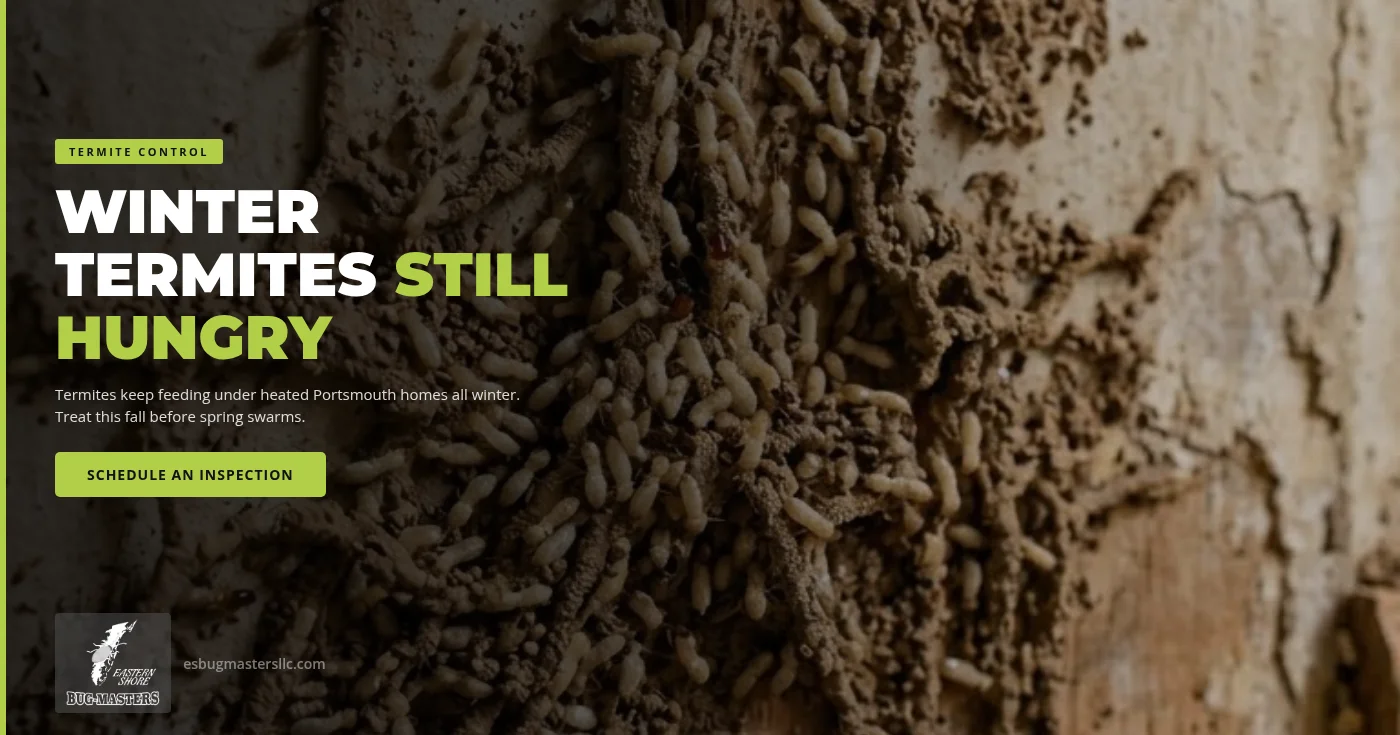
When the leaves drop and the furnace kicks on, most homeowners assume pests are done for the year. Termites didn’t get the memo. Beneath many older houses, eastern subterranean termites keep chewing through sill plates, floor joists and porch framing all winter. That’s why fall is one of the smartest times to think about termite treatment in Portsmouth, VA.
Our coastal climate makes the problem worse. Mild winters, a high water table, nor’easter rains and plenty of early-1900s homes give colonies moisture, warmth and wood. Here at Eastern Shore Bug Masters, we see winter termite activity across Hampton Roads every year, and it often goes unnoticed until swarmers appear in spring.
Below, we explain why termites keep feeding in the cold, which homes are most at risk, what signs to check for, how treatments compare and which prevention steps to take before swarm season.
Short answer: no. Eastern subterranean termites (Reticulitermes flavipes), the main structural termite in Virginia, don’t hibernate. They live in underground colonies and travel through soil and mud tubes to reach wood. When surface temperatures fall, workers move deeper into the soil, where conditions stay more stable. Extension entomologists, including the University of Kentucky’s Department of Entomology, note that colonies feeding on wood in or under heated buildings may stay active right through winter.
Our ground rarely freezes deeply. November highs often sit around 60°F, and even in January the soil beside a foundation is warmed by the house itself. A colony that has already found your crawl space framing has little reason to leave.
Feeding may slow during the coldest stretches, but it rarely stops when food, warmth and moisture sit just above the soil. Damage that builds quietly from November through February is still damage, and it adds up. Because termites work inside wood, many homeowners don’t realize anything is wrong until a spring swarm or a soft floorboard gives the colony away. Winter termite activity is easy to miss precisely because it happens out of sight.
Termites are fragile insects. They dry out quickly in open air, so they depend on moisture to survive. The U.S. Environmental Protection Agency points to damp soil, leaks and wood touching the ground as major conditions that attract subterranean termites. Coastal homes often have all three.
A heated home radiates warmth into its foundation and the surrounding soil. For a colony, that warm zone is a winter refuge sitting right beside a steady supply of structural lumber.
Crawl spaces in our region tend to stay humid. Many homeowners close foundation vents in fall to keep floors warmer, which can trap humidity under the house. Add a slow plumbing leak, a downspout dumping water against the foundation or a bare dirt floor, and framing can stay damp enough for termites to thrive. That’s a common path to crawl space termite damage, and it’s why we often pair treatment with crawl space moisture control.
High water tables, tidal nuisance flooding in neighborhoods like Olde Towne and Park View, and heavy fall nor’easters keep soil wet for long stretches. Moist, sandy soil is easy for workers to tunnel through, which makes termite prevention in Hampton Roads a year-round concern rather than a spring-only job.
The city’s historic neighborhoods are part of what makes it a great place to live, and part of why termites love it. Many homes in Olde Towne, Park View and Cradock were built in the early 1900s with wood framing, raised floors on brick piers and deep front porches. Those features carry real character, but they also create entry points.
Older homes have usually passed through several owners, each with their own repairs, so it’s hard to know whether a past treatment is still active. If you can’t find paperwork showing a current treatment or monitoring plan, it’s wise to assume your protection may have lapsed. A careful inspection of the crawl space, porch and foundation is the best way to know where your home stands, and it’s the first step in protecting a house that has already stood for a century.
You don’t need to be an expert to spot early warning signs. Grab a flashlight on a dry afternoon and check these areas:
Fall is a good time to look under the house before it gets too cold. Check piers for mud tubes, look for darkening or staining on joists and note any wood touching the soil. Standing water and condensation are red flags too. Subterranean termites rarely leave the sawdust-like droppings people associate with drywood termites, so don’t wait to see piles of debris. If you spot something suspicious, leave it undisturbed so a technician can confirm whether the activity is current.
Spring swarm season in Virginia usually runs from about March through May, often on a warm day after rain. By the time swarmers appear, a colony has typically been established for years. Treating in late fall means your barrier or bait system is already in place and working before spring activity ramps up.
Soil-applied termiticides generally shouldn’t go into frozen or waterlogged soil, and each product label sets the rules. Our dry, mild late-fall days are usually well suited to application. We watch the forecast and schedule around heavy rain so the treatment settles properly into the soil.
Fall brings practical advantages, too. Foliage has died back, so foundations are easier to see. Crawl spaces are far more comfortable to inspect than in August heat, and scheduling is usually more flexible than during the spring rush.
A termite inspection Portsmouth VA homeowners book now also leaves time to fix moisture issues, remove wood-to-soil contact and plan repairs before the busy season. Here at Eastern Shore Bug Masters, we’d much rather help you get ahead of a colony in November than chase swarmers through your kitchen in April.
No single treatment fits every home. The right approach depends on construction, soil, moisture and how active the colony is. According to the EPA, the main options for subterranean termites are liquid soil treatments, baits and wood treatments.
Liquid termiticides are applied to the soil around and beneath the foundation to create a treated zone. Many modern products, such as those using fipronil or imidacloprid, are non-repellent, so termites don’t detect them and carry the active ingredient back to the colony. Many labels describe protection lasting several years, though results vary by product and conditions.
Bait stations go into the ground around the home and are monitored over time. Termites feed on bait containing a growth regulator such as hexaflumuron or noviflumuron and share it through the colony. Baits suit homes where treating soil is difficult.
Feeding at bait stations can slow in cold soil, so baits may take longer to show results over winter. Liquids can start working soon after application when soil conditions meet label requirements. Sometimes we recommend combining both.
Borate treatments can protect exposed crawl space framing, and correcting moisture problems makes your home far less inviting. Treatment works best when the conditions that attracted termites are fixed, too.
Professional treatment is your main line of defense, but simple habits make a real difference. Here’s what we recommend every fall:
Fall is also when other pests look for a warm place to spend the winter. Our general pest control service helps keep spiders, roaches and other invaders out alongside your termite plan, so your home gets complete protection through the cold months.
In many cases, yes. Eastern subterranean termites don’t hibernate. They move deeper into the soil when it’s cold, and colonies feeding near or under heated homes can keep working all winter, especially along the mild coast.
Termites can be treated almost any time the soil isn’t frozen or saturated, but late fall is a strong choice. It puts protection in place before spring swarms and usually offers easier scheduling and mild application weather.
It depends on the product and conditions. Many liquid labels describe several years of protection, while bait systems rely on ongoing monitoring. We’ll explain what to expect from your plan, including follow-up inspections.
No. Termite swarmers have straight antennae, a thick waist and two pairs of equal-length wings. Flying ants have elbowed antennae, a pinched waist and front wings longer than the back ones. If you’re unsure, save a sample for us to examine.
Cold weather doesn’t send termites away; it just hides them. Heated homes, damp crawl spaces and historic wood framing give colonies everything they need to keep feeding until spring. Scheduling termite treatment Portsmouth VA homeowners can rely on this fall puts protection in place before swarm season begins.
Here at Eastern Shore Bug Masters, we serve homeowners across Hampton Roads, including Norfolk, Virginia Beach, Chesapeake, Suffolk, Hampton, Newport News and Williamsburg. Explore our service area, then contact us to schedule your termite inspection. We’ll check your crawl space, foundation and porch, explain what we find in plain language and recommend a plan that fits your home.
We can. Here at Eastern Shore Bug Masters, we help homeowners stop termites during the months when most people assume the problem has gone quiet. Fall and winter are when colonies keep feeding under heated homes, and they’re also when we have the time and the weather to treat thoroughly.
When you schedule a visit, we start with a careful inspection of the places termites love most:
From there, we recommend a plan built around your home, not a one-size-fits-all package. That might be a liquid soil barrier, a monitored bait system, a borate wood treatment or a combination. Because moisture is so often the root cause, we can also pair your plan with crawl space moisture control so termites find your home far less inviting.
We follow every product label, schedule around heavy rain and explain each step in plain language, so you always know what we’re doing and why. Our goal is simple: give you peace of mind long before swarmers appear in spring.
Learn more about our termite treatment services, or reach out to us to book your fall inspection. We’re ready to help you protect the home you love, one crawl space at a time.