If you've noticed new webs across your porch railings, more sightings in the garage, or an unfamiliar spider skittering across the bathroom floor after dark, you're seeing the same pattern hundreds of Virginia Beach homeowners notice every September. Late-summer heat holds through the month, coastal humidity stays high, and the adult spiders that spent all season maturing outdoors start showing up inside. If you're weighing whether to invest in spider control in Virginia Beach, VA this fall, the timing is right — the reasons behind the surge are seasonal, predictable, and manageable once you understand them.
September marks the peak of spider activity for coastal Virginia for one simple reason: this is when most local species reach maturity and males start wandering long distances in search of mates. The spiders you're noticing didn't just appear — they've been growing outside on your property all summer, under mulch, along fence lines, in shrubs, and in garage corners. Now the mating window has opened, and the males are on the move.
Two other seasonal shifts amplify the effect in Virginia Beach. First, coastal humidity remains high well into October, which supports the outdoor insect populations that spiders feed on. Every mosquito, gnat, moth, and small fly that survives late summer becomes a potential meal, and spiders follow their food source. Second, the first cool nights of the year — those crisp evenings that feel like early fall — push many species to seek out sheltered, warmer spaces during the day. Attics, garages, basements, and window sills all become attractive real estate.
The pattern layers on top of Virginia Beach's regular coastal pressure. Homes near the Chesapeake Bay, the Atlantic, and the Lynnhaven watershed sit in habitats where spider populations flourish year-round. What changes in September isn't the underlying population — it's the visibility. Adult males on the move end up inside more often than the females holding webs outdoors, and that's why calls for spider control in Virginia Beach spike every year around Labor Day.
Coastal Virginia hosts dozens of spider species, but a handful account for the majority of the sightings inside homes. Recognizing what's on the wall or in the corner helps you decide how urgently to act. Here are the species we most frequently identify during fall inspections in Virginia Beach:
The exact mix on any given Virginia Beach property depends on landscaping, drainage, proximity to woods or water, and how much outdoor lighting attracts flying insects at night. Most homes we inspect in September have three to five of these species present in noticeable numbers.
The question we hear most often on service calls this time of year is whether the spider someone just spotted is dangerous. The honest answer for Virginia Beach: the vast majority are not, but two species do warrant real caution.
According to the Virginia Cooperative Extension, the two species of medical concern in Virginia are the black widow and the brown recluse. Of those, the black widow is present throughout the coastal plain including the Virginia Beach area, while the brown recluse is rare east of the Blue Ridge and only occasionally documented in Tidewater. Both are shy, secretive spiders that hide in cluttered, undisturbed spaces — under woodpiles, inside stored boxes, behind garage shelving, in outdoor sheds. Neither is aggressive toward people, and bites almost always happen when the spider is accidentally pressed against skin.
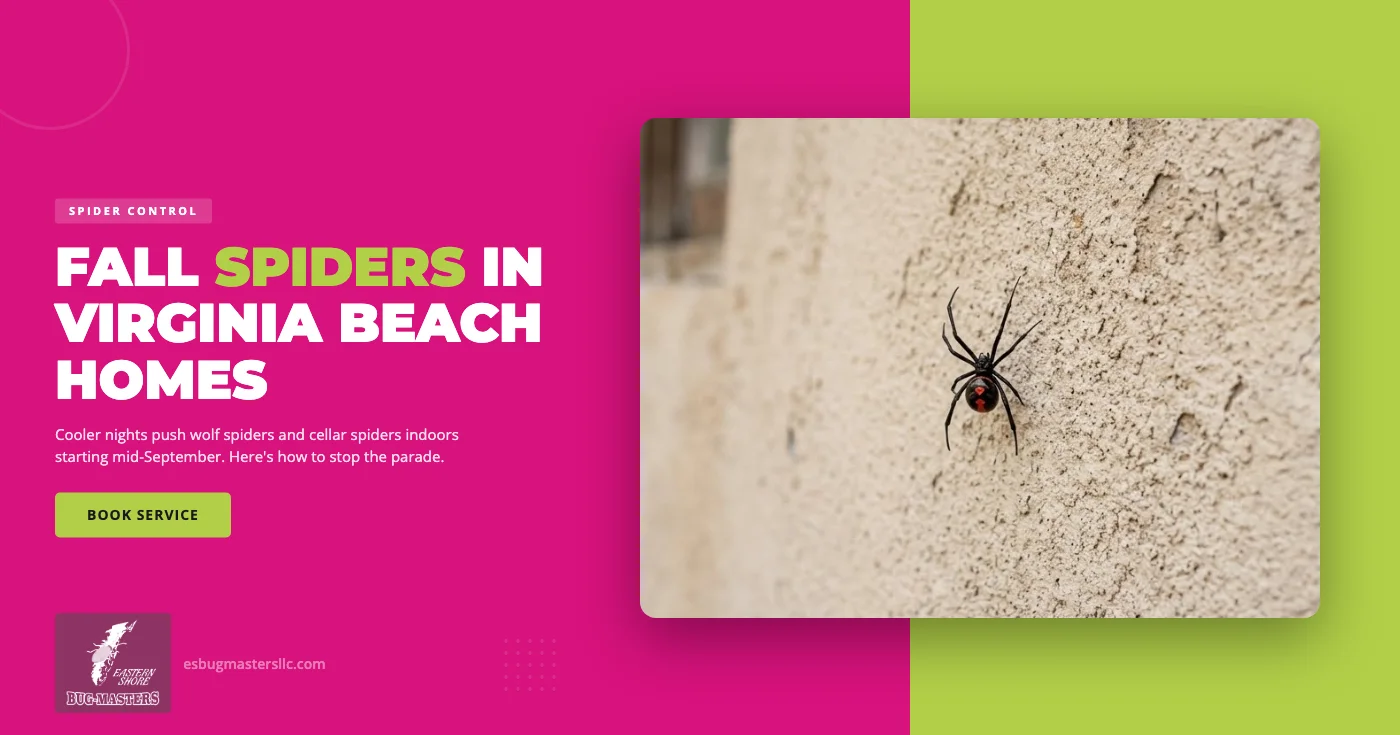
Black widows are the more common concern in Virginia Beach and worth knowing on sight: adult females are glossy black with a red hourglass on the underside of the abdomen. If you find one — especially in a garage, shed, crawl space, or garden bed — treat it seriously. Do not attempt to handle it. Bites can require medical attention, particularly for children, older adults, or anyone with underlying health conditions. If you're seeing widow spiders on a property, professional spider control in Virginia Beach, VA is the sensible next step rather than a DIY approach.
Everything else — wolf spiders, common house spiders, cellar spiders, yellow sac spiders, orb weavers — is essentially harmless to healthy adults. Bites from most local species produce a mild welt at worst and are far less common than folklore suggests. What most people react to and call "spider bites" are often reactions to mosquitoes, fleas, or bed bugs, according to the same Virginia Cooperative Extension guidance.
Fall spider activity concentrates in specific parts of Virginia Beach homes. Knowing where to look helps with both DIY reduction and deciding when to bring in a professional. During inspections we consistently find the highest spider activity in these areas:
Beyond individual rooms, the most productive spider habitat in a Virginia Beach home is often the transition zone between indoors and out — the garage door threshold, the space around dryer vents, the gap under exterior doors. Spiders following insects don't move through these gaps deliberately; they simply drift along the same routes their prey uses.
DIY prevention works well for the common, harmless species and reduces the underlying pressure that draws spiders inside. These steps are the ones we recommend most often to Virginia Beach homeowners and consistently see results from when applied through September and October:
Consistency matters here. A one-time sweep of the garage and a single caulking session won't hold up against September's mating-season pressure. The homeowners who see the best results build a routine — a weekly vacuum pass, a monthly perimeter check, a seasonal sealing tune-up — and stick with it through October.
DIY handles the routine, harmless species well. But there are situations where professional treatment is the more responsible choice, and Virginia Beach homeowners see all of them in September:
Our approach to spider control in Virginia Beach starts with a thorough inspection of the property — inside living spaces, garages, basements, crawl spaces, sheds, and the exterior perimeter. We identify the species present, the entry points they're using, and the outdoor habitat feeding the population. Every treatment plan we recommend is built around that inspection, not a one-size-fits-all package.
For active infestations we apply targeted treatments where spiders shelter and hunt, along with perimeter applications that reduce the outdoor insect pressure spiders are following. We handle the medically significant species with the caution they deserve and pair that with straightforward advice on the changes around the property that will keep populations lower in future seasons. Recurring service through our General Pest Control program keeps the perimeter protected year-round. For a full look at what we treat and how, our Pest Services page walks through every option we offer.
One thing we want to be transparent about: no responsible pest control company can promise your Virginia Beach home will be 100 percent spider-free. Adults wander in from surrounding habitat regardless of what you do on your own property. What we can deliver is a dramatic reduction in indoor activity, targeted treatment for any medically significant species we identify, and peace of mind that a licensed team is watching your property.
If September's spider activity has pushed past your patience, we're ready to walk the property, identify what's driving the sightings, and build a plan that fits how you actually live at home. Contact us today to schedule spider control in Virginia Beach, VA.