
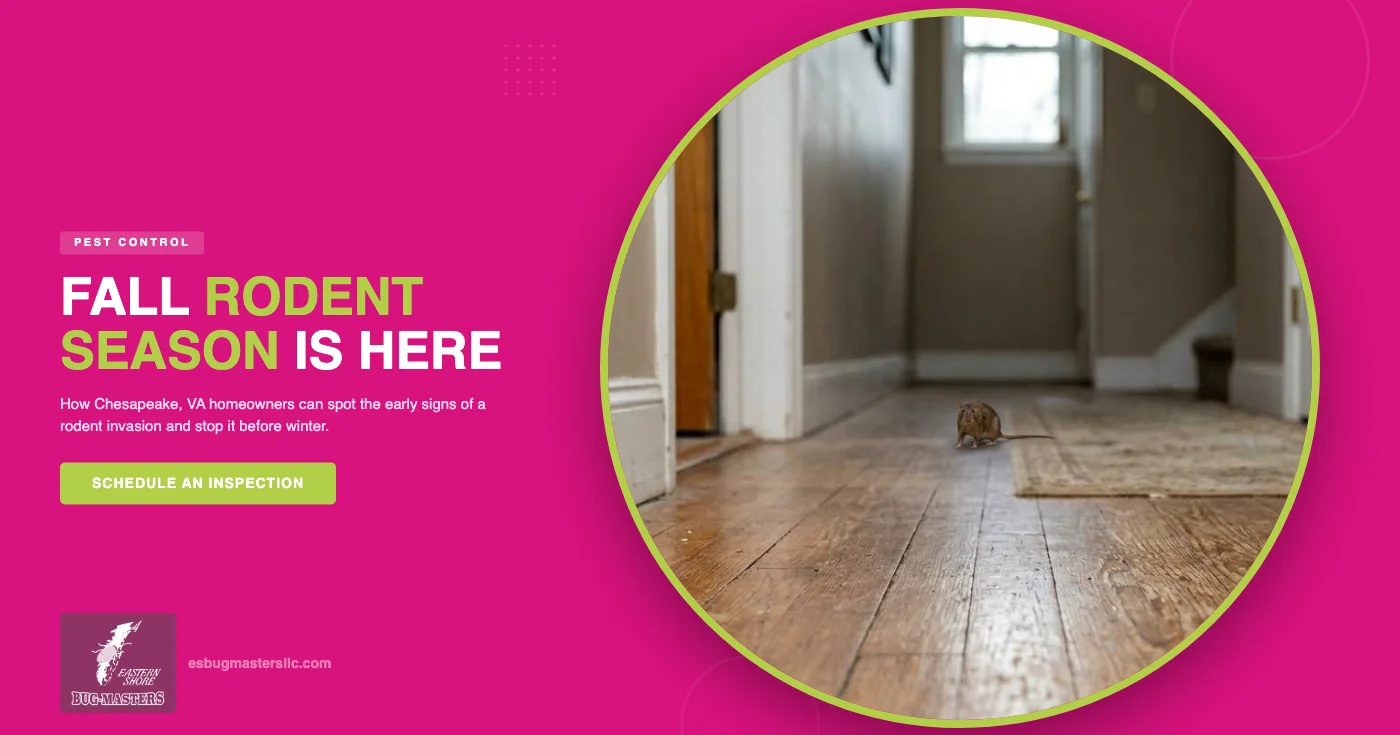
If the pantry sounds busier at night, if the dog fixates on a corner of the kitchen after dark, or if you have found a scattering of grain-of-rice droppings behind the coffee maker, you are watching the annual fall rodent push start. Mice and rats abandon fields, marsh edges, and outbuildings this time of year to look for shelter, water, and food inside heated homes. Rodent control in Chesapeake, VA gets busier every September for exactly this reason, and the sooner you catch the pattern, the smaller the problem stays.
Coastal Virginia offers rodents an unusually generous shoulder-season buffet. The first cool nights of September push house mice and Norway rats out of the fields and marsh edges that ring the city and toward the warm, dry structures a mile inland. According to the University of Kentucky Department of Entomology, most household pests seek refuge in buildings in response to seasonal cool-downs and extended weather swings, and the local microclimate delivers both.
Coastal humidity keeps rodents active longer. The tidewater is milder than inland Virginia, so litters produced late in the season have time to reach breeding age before winter shuts them down. A single female house mouse can produce five to ten litters per year in favorable conditions, which is what turns a small September problem into a very large December one.
Storm patterns loosen the building envelope. The nor'easters and remnant hurricanes that track through Hampton Roads shift soil around foundations, crack crawlspace vents, and pop loose flashing on soffit corners. Every new opening reads as an invitation, and inspection findings on Chesapeake, VA properties tick up sharply this time of year.
Rodent control in Chesapeake, VA is fundamentally a fall discipline. The homes that catch a mouse population at ten stay simple to protect; the ones that catch it at a hundred turn into a months-long remediation project.
The single most useful piece of information from the University of Kentucky's pest-proofing guidance is the number every homeowner should have in their head: mice can slip through a gap the width of a pencil (about a quarter of an inch), and rats need only half an inch. Any opening a dime can pass through is a working door.
Here are the entry points our inspectors flag most often on Chesapeake homes.
Garage-door corners. The rubber gasket at the bottom of the garage door hardens and shrinks in the summer sun, leaving a triangular gap at each corner. From late August through November, roughly a third of the rodent calls we run start here.
Utility penetrations. Where cable, gas, water, and HVAC lines come through the foundation or siding, the installer usually left a gap wider than the pipe. Foam and caulk crumble in coastal humidity; steel wool packed tight, capped with silicone sealant, is what actually holds up.
Weep holes in brick veneer. Brick homes need weep holes for moisture management, and mice know it. Weep holes covered with 1/4-inch galvanized hardware cloth still weep and no longer welcome traffic.
Crawlspace vent screens. Original screens rust through in coastal humidity within a decade. A rusted-out screen is a wide-open runway to the joists, subfloor, and eventually the wall voids above.
Roof and soffit lines. According to the Virginia Department of Health, roof vents, eaves, attic vents, and overhangs are common elevated entry points, and roof rats will use overhanging tree branches as a runway to reach them. Any limb within four feet of the roofline is a bridge.
Dryer vents and range hoods. The flapper doors seize open once lint accumulates behind them. A stuck-open dryer vent is a straight shot into the laundry room wall.
Our Rodent Control service starts with a full-perimeter exclusion inspection, because sealing one entry point with three others open does not solve the problem.
Mice and rats are quiet neighbors until they are not. Homeowners usually notice one of these signals before they see the rodents themselves.
Droppings. House mouse droppings are dark, pointed at both ends, and roughly the size of a grain of rice. Norway rat droppings are two to three times larger and blunt-ended. Fresh droppings are dark and pliable; older ones are gray and crumble under pressure. Both concentrate around food sources, along baseboards, and inside pantry drawers.
Gnaw marks. Rodents' incisors grow continuously, so they chew almost constantly to file them down. Look for tooth marks on wood corners, plastic food packaging, and, most concerning, electrical wire insulation. The Virginia Department of Health notes that gnawed wiring has caused a real share of house fires attributed to unknown causes.
Grease rub marks. Rodents follow the same routes over and over, and their oily fur leaves a dark smudge along baseboards, in floor-joist runs, and at the edges of entry holes.
Scratching or scurrying sounds after dark. House mice are most active in the first few hours after sunset. Movement in the wall behind the headboard or above the bedroom ceiling means the colony has moved past a single scout.
Musty ammonia odor. Rodent urine carries an unmistakable ammoniac smell that concentrates under sinks, inside pantries, and at the back of hall closets. Norway rats destroy roughly ten times as much stored food through urination and defecation as they actually consume, and that smell is often the first evidence.
Pet behavior. Dogs and cats notice rodents before we do. A pet fixated on a specific baseboard, register vent, or cabinet corner is worth taking seriously — especially if the behavior started in the last two weeks.
Any two of these signs in the same room means there is already an active population, and rodent control in Chesapeake, VA is far more effective the earlier it starts.
Before we ever set foot on a property, there is real work a homeowner can do that pays off through the whole fall.
Walk the perimeter with a flashlight and a dime. Anywhere the dime passes through the gap, mark it with painter's tape. Come back through with copper mesh or steel wool packed tight, then finish with silicone sealant or low-expansion foam.
Install door sweeps on every exterior door. The gap under an exterior door is the single most-missed entry point on an American home. A rubber-and-brush door sweep costs a few dollars and blocks the easiest route inside.
Trim tree branches back from the roofline. The Virginia Department of Health recommends keeping branches trimmed away from structures. A four-foot clear zone around the roof and gutter is a reasonable minimum. Roof rats do not fly; they walk in.
Maintain a three-foot vegetation-free perimeter. Weeds, mulch heaped against siding, and stacked firewood next to the house all give rodents cover to work on your foundation without being seen. Push mulch back to eight inches off the foundation and store firewood on a rack at least three feet from any structure.
Store food and garbage in sealed containers. Pet food left in the garage is one of the biggest attractants we find on local properties. Heavy plastic bins with lockable lids solve the problem overnight. Kitchen trash lids should snap or latch, not simply rest on top.
Deal with moisture. Coastal humidity plus a leaking hose bib, a puddling downspout, or a slow crawlspace drip becomes a full-service rodent lounge. Fix visible leaks, extend downspouts three to four feet away from the foundation, and ask about crawlspace encapsulation if you have not already looked into it.
Skip the snap-trap-and-bait combos without a plan. A single bait station in the wrong place can push rodents into wall voids to die there. Trapping works, but it works best inside a documented exclusion plan.
DIY prevention is worth doing every fall. Professional rodent control in Chesapeake, VA is worth calling in when any of the following becomes true.
You are seeing rodents during daylight. Mice and rats are nocturnal. Daytime sightings mean the population has outgrown its food supply and is searching more aggressively — a strong indicator of a mature colony.
Droppings are showing up in multiple rooms. A single infested room can be a wandering scout. Droppings in the kitchen, the laundry, and the attic together point to a colony that has already mapped highways through the house.
You have heard rodents in the walls or attic for more than two weeks. Wall-void nests grow fast, and drywall does not slow chewing. Left alone, the population expands into insulation, HVAC ductwork, and electrical wiring — and rodent control in Chesapeake, VA gets substantially more expensive at that point.
A previous DIY approach has stopped working. Bait that got eaten twice and then ignored, traps that stopped catching, sealed entries that opened up again — these are all signs the population has learned and adapted. Pulling in professional help early is far less expensive than late.
Anyone in the household is immunocompromised, pregnant, or under two years old. Rodent-borne pathogens carry higher stakes for those populations, and the response window shrinks accordingly.
Commercial or food-service property. Rodent activity at a business triggers regulatory attention and reputational risk a homeowner does not face. The response has to be faster and more thoroughly documented.
Rodent control in Chesapeake, VA in our hands is a four-step sequence built around the biology of house mice and Norway rats, the two species behind roughly 95 percent of local residential calls.
Full-property inspection. We start by mapping every active runway, entry point, harborage area, and food source. That means crawling the crawlspace, walking the attic, and checking every utility penetration outside. The written report is the plan for everything that follows.
Trapping first, baiting second. For active interior populations, we prefer trap-based reduction. Traps take rodents out immediately, keep the carcasses accessible for removal, and avoid the wall-void die-off problem that comes with poorly placed bait. Bait stations get deployed outside in tamper-resistant boxes for ongoing perimeter pressure.
Exclusion — the part homeowners actually pay for. This is the difference between a treatment and a solution. We seal every entry point the inspection turned up with materials rodents cannot chew through: copper mesh in tight gaps, hardware cloth over larger openings, sheet-metal patches at critical wear points. Exclusion is where rodent control in Chesapeake, VA stops being a monthly expense and starts being a one-time fix.
Ongoing monitoring. For clients on recurring service, exterior bait stations are checked and refreshed on a schedule through fall and winter. Interior stations, if any, come down as soon as monitoring confirms the population is out. No responsible pest control company can promise a home stays rodent-free forever — the fields, marshes, and neighboring yards keep sending scouts — but consistent perimeter pressure and a sealed building envelope leaves those scouts nowhere to land.
Rodent pressure in Chesapeake, VA peaks in October and November but never fully stops. Milder winters in coastal Virginia mean a house mouse population inside a warm attic can reproduce year-round, and the fall exclusion work that keeps them out in October pays dividends every subsequent month. The properties that stay quiet are the ones that treat the building envelope as long-term infrastructure — sealed, monitored, and adjusted as the home ages.
If you have seen droppings, heard scurrying, or found gnaw marks anywhere on the property, the next step is a professional inspection. We can be at your home within days to walk the perimeter, deliver a written exclusion plan, and shut the rodent season down before winter locks it in. Learn more about our Rodent Control program or our full General Pest Control service, then contact us to schedule your fall inspection.