
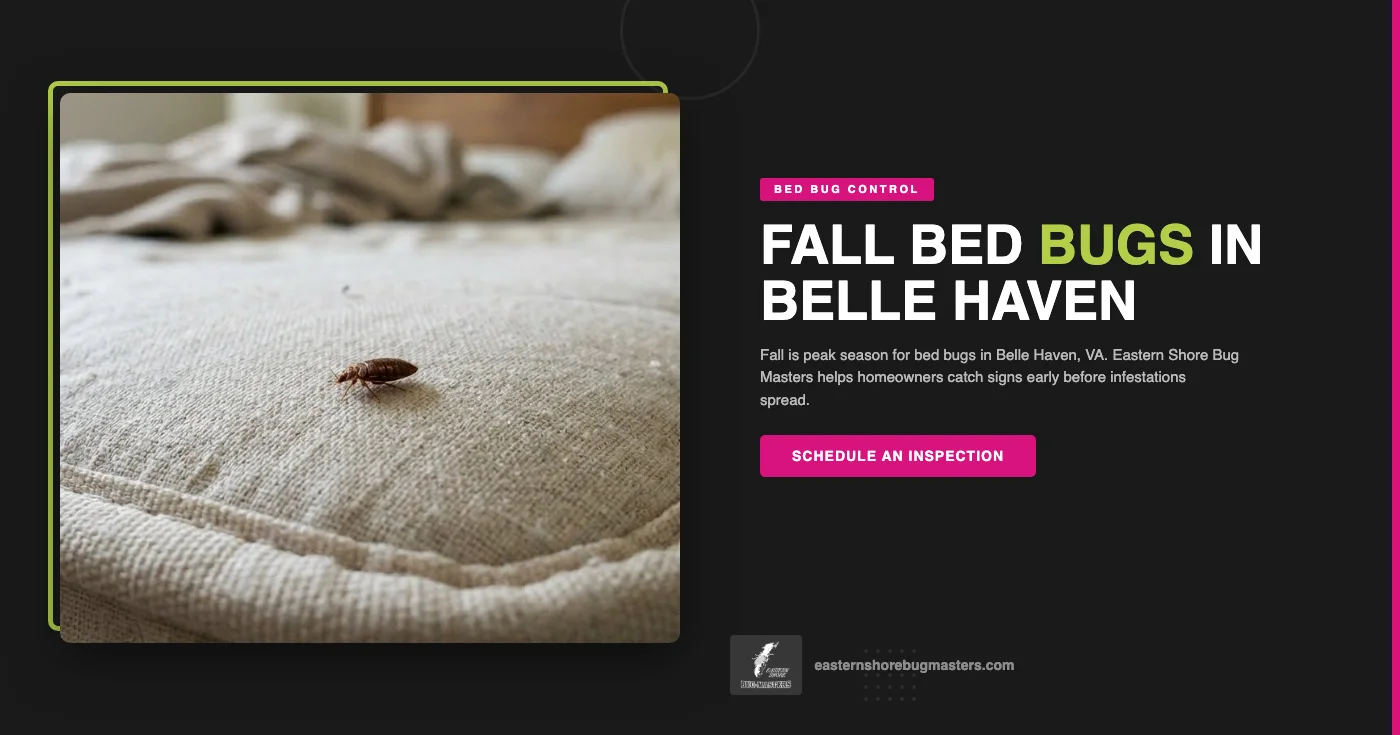
If you have found small rust-colored specks along the seam of a bedroom mattress, welts on the arm after sleeping, or the odd pinhead-sized shell tucked behind the headboard, you are looking at the same pattern we see in Belle Haven homes every autumn. Late summer and fall are the busiest months of the year for bed bug calls across the Eastern Shore, and it has nothing to do with a temperature spike. Bed bugs travel the way people travel — and September through the holidays is when families move around the most. If you are weighing whether to schedule professional bed bug control in Belle Haven, VA before the trouble spreads, the calendar makes the case: a colony you can catch this month may take one visit, and the same colony in December may take three.
Bed bugs, unlike most household pests, are almost weather-independent. They live inside conditioned spaces year-round, and the outdoor cold snaps that shut down ants and mosquitoes have no effect on a colony living behind a headboard on the Eastern Shore. What does change dramatically with the season is human movement — and human movement is the entire reason bed bugs get from one home to another.
Late August through November is the busiest travel stretch of the year for coastal Virginia. College students come home for fall break and Thanksgiving. Families take end-of-summer beach trips before school starts. Extended relatives host reunions and holiday gatherings. Delivery drivers, contractors, and HVAC crews rotate through more homes as homeowners prep for cold weather. Every one of those movements is a potential bed bug introduction.
Virginia Cooperative Extension traces the modern resurgence in bed bug cases across the state to three overlapping factors — increased travel, secondhand furniture turnover, and widespread pesticide resistance — and all three peak in the fall months. Coastal humidity holds through October across Accomack County, which keeps indoor conditions comfortable for a colony hiding in wall voids and box springs long after outdoor bugs have gone quiet for the year. Bed bug control in Belle Haven, VA gets more urgent this time of year because every week of delay compounds while the bugs keep reproducing on schedule.
Bed bugs do not fly, do not jump, and do not wander across a yard on their own. Every infestation in a Belle Haven home traces back to something — or someone — that carried the bugs across the threshold. Understanding the entry points makes prevention practical.
Travel luggage. Hotels, vacation rentals, and short-term stays account for the largest single share of the cases we see. A single fertilized female tucked into a suitcase seam can start an entire colony once the bag lands on a bedroom floor.
Secondhand furniture. Curbside finds, thrift shop sofas, hand-me-down mattresses, and "free" listings on local trade groups have all been the source of bed bug introductions on the Eastern Shore. Upholstery and mattress seams are ideal hiding places.
Guests and visitors. Overnight guests unknowingly carrying a few bugs on clothing or in overnight bags will seed a bedroom during a weekend stay. This is a common source right before and right after major holidays.
Kids returning from campus. Dorms and shared student housing are notorious bed bug environments. A duffel bag from fall break brings whatever the room had along with it.
Service technicians and delivery drivers. Anyone who moves between homes for a living can pick up hitchhikers at one property and drop them at the next. Furniture delivery crews and appliance installers rank highest in this category.
Adjacent units in multi-family housing. In apartments, condos, and duplexes, bed bugs migrate through wall voids, plumbing chases, and electrical outlets from a neighbor's unit. Attached-dwelling cases get inspected on every shared wall.
The reason bed bug problems get out of hand is that the first live bug is rarely the first sign. By the time anyone spots a bug on the bedding, the colony has been active for weeks. Our team looks for these markers first on every inspection, and homeowners can look for the same signs during a bedroom walkthrough.
Bite patterns. Bed bug bites usually appear in straight lines, zig-zags, or clusters of three or four welts — often on the arms, shoulders, neck, or ankles. Reactions vary widely: some family members develop pronounced welts within hours, others show nothing for days. If only one household member has bites and they appear only after sleeping, that is a bed bug investigation until proven otherwise.
Fecal staining. Small dark rust-colored or coffee-colored spots along the mattress seam, piping, or fabric behind the headboard are bed bug fecal marks. They usually appear in clusters or trails rather than isolated dots.
Crushed-bug smears. Reddish-brown streaks that look like dried blood on the sheets are exactly that — a bed bug crushed by a sleeper during the night.
Shed skins. Tiny pale shells the size of a sesame seed, often collected along the box spring seam or in the joint where the headboard meets the wall, are the exoskeletons the bugs shed as they molt through five nymph stages.
Eggs and egg cases. White pinhead-sized eggs, often cemented in cracks and crevices, indicate an established colony that has been reproducing.
Sweet, musty odor. Heavy infestations produce a sweet, slightly berry-like odor from the bugs' aggregation pheromone. Once you have smelled it, you will not confuse it with anything else in a bedroom.
Live bugs after dark. Bed bugs are nocturnal. A homeowner who suspects an infestation can sit in a dark bedroom around 2 a.m. and switch on a flashlight — active bugs on the sheet confirm the case in minutes.
Every bed bug case we work on the Eastern Shore has the same first data point: how long the homeowner waited before calling. A one-bedroom problem caught in week two often takes one heavy treatment and a follow-up visit. The same problem left alone for three months regularly needs a whole-house treatment across three or four visits. The math behind that gap is not complicated.
Reproduction is fast and continuous. A single fertilized female lays one to five eggs per day, and eggs hatch in 6 to 10 days. Two weeks of hesitation can turn ten bugs into a hundred. Two months turns a hundred into a colony spread across every room where anyone sleeps.
DIY sprays scatter the population. Bed bugs have developed widespread resistance to most over-the-counter pesticides, according to Virginia Cooperative Extension. A heavy hardware-store spray application often knocks down visible bugs while driving the surviving colony deeper into wall voids, outlets, and adjacent rooms. A single bedroom problem can become a whole second floor within a week of the wrong DIY treatment.
Foggers and bug bombs are worse than nothing. Total-release foggers push bed bugs away from the treated area without reaching the cracks and crevices where they live and lay eggs. Every entomology publication in the state discourages their use for this reason.
Heat DIY has its own risks. Space heaters set up to "cook" a bedroom rarely reach the sustained 120 degrees needed to kill eggs inside mattress cores, and they have caused fires and warped floors in the process.
The takeaway from every real-world Belle Haven case: catch it early, involve a professional, and the whole thing stays manageable. Wait too long, and you have signed up for a much longer, much more expensive project. Bed bug control in Belle Haven, VA becomes exponentially harder the longer a colony has to spread.
A professional bed bug treatment is not a stronger can of spray. It is a sequenced process built around the biology of the bug, and every step exists because a shortcut somewhere else has failed for someone before.
Inspection and confirmation. Every case starts with a room-by-room visual exam, beginning at the bedrooms and working outward to any space where anyone naps, reads, or watches TV. Our team pulls mattresses, lifts box springs, checks behind headboards, moves dressers away from walls, and examines upholstered furniture. Roughly one call in five turns out to be flea bites, mosquito reactions, or an unrelated skin condition — confirming the pest is the first step because the treatment is completely different for each.
Written treatment plan. Once we confirm bed bugs and identify the boundaries of the infestation, we build a plan that reflects the home's layout, the severity of the case, the children and pets in the household, and the timeline the family needs. That plan gets shared before any product is applied.
Multiple visits, spaced deliberately. Most cases resolve in two or three visits spaced 7 to 14 days apart. The follow-up visits exist because no product kills bed bug eggs perfectly — the second and third visits catch newly hatched nymphs before they mature and reproduce. Any company that promises a one-and-done is overselling what is actually possible.
Targeted product selection. Depending on the case, we may use residual liquid treatments in mattress seams and crevices, insecticidal dust in wall voids and outlets, mattress and box-spring encasements, and monitoring devices that verify activity after treatment. Heat treatments make sense in specific severe cases where structural conditions allow the required sustained temperatures.
Ongoing verification. Bed bug elimination is an evidence-based process. Follow-up inspections and monitoring devices confirm the colony is done rather than relying on the homeowner to notice bites have stopped.
One thing we tell every homeowner asking about bed bug control in Belle Haven, VA up front: no responsible pest control company can promise that a treated home will never see another bed bug, because the next fertilized female is only ever one hotel stay or one guest visit away. What we can promise is a documented, methodical elimination of the colony you have right now and a plan to catch the next introduction before it spreads.
Every Belle Haven bed bug case we handle starts the same way. A team member walks the home, confirms the pest, maps the boundaries of the infestation, and builds a written plan that accounts for the family, the pets, and the layout of the property. From there, the treatment sequence is the one Virginia entomologists have validated for decades: targeted product placement in the cracks and crevices where bed bugs actually live, plus mattress encasements, monitoring devices, and follow-up visits spaced to catch the eggs hatching after the first treatment.
Our team lives and works across the Eastern Shore. We know which Belle Haven neighborhoods see the most cases after Labor Day, which secondhand furniture sources in the surrounding counties have shown up in past investigations, and which travel corridors the recurring infestations most often come home from. That local knowledge shortens every inspection and sharpens every prevention plan.
For homeowners who want ongoing protection beyond a single bed bug case, our General Pest Control program covers the seasonal pests that follow every autumn — rodents, spiders, cockroaches, and the ants that push indoors on the first cold nights. A quarterly perimeter treatment keeps the pressure off while our bed bug program handles the acute problem inside. For the full slate of what we treat and how, our All Pest Services page walks through every option, from single-visit bed bug treatments to year-round protection plans.
If you have noticed any of the warning signs on your Belle Haven property this fall — unexplained bites in a linear pattern, dark specks along a mattress seam, or a pale shell tucked behind a headboard — the next step is a professional inspection while the case is still small. Contact us today to schedule bed bug control in Belle Haven, VA and get an honest recommendation before the colony has another month to grow.