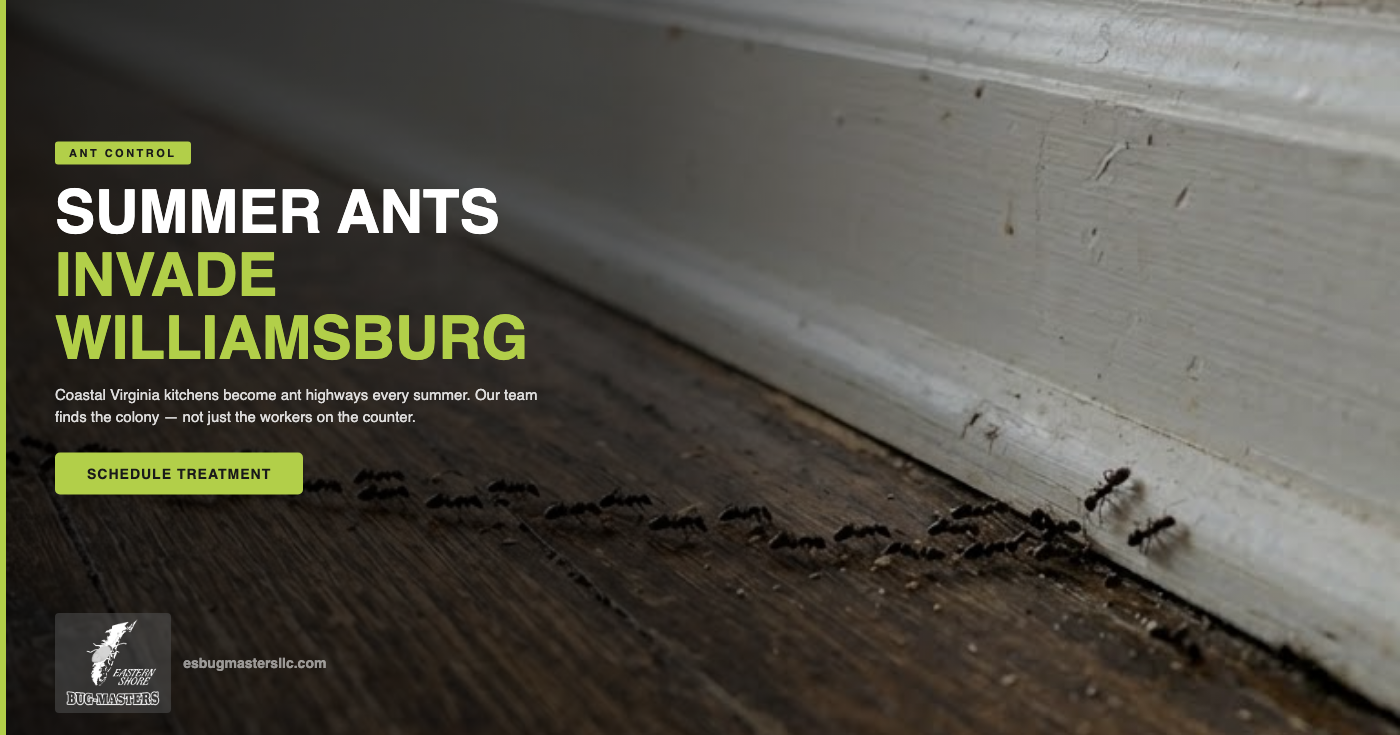
It always starts the same way. A few scout ants in the kitchen one morning, then a trail along the baseboard by the weekend, then a line of them running across the bathroom counter. If you have started searching for ant control in Williamsburg, VA, you are not alone — 2026 is shaping up to be one of the busiest ant seasons our area has seen in years.
At Eastern Shore Bug Masters, we have spent years treating ant problems across Hampton Roads and the Peninsula, and the same patterns show up every June: a few warm weeks pull colonies out of the ground, the first heavy rain pushes them toward foundations, and suddenly every kitchen in the neighborhood is hosting a small invasion. This guide covers why our area is such a magnet right now, the species you are likely facing, the signs an indoor problem is getting worse, where DIY fixes hit their limit, and how a professional general pest control program puts the problem behind you.
Williamsburg sits in the sweet spot for ant pressure. Hot, humid summers push colonies into a long active season — most species in our area start foraging hard in late April and do not let up until October. Add the historic neighborhoods, mature tree canopies, and damp landscaping common around Williamsburg-James City County, and you get the kind of warm, moisture-rich habitat ants love.
The 2026 spring made it worse. A drier-than-average April and May across Hampton Roads forced colonies to push deeper indoors looking for water, and reports of in-home ant trails have run noticeably higher than past years across the 757. When the ground dries out, ants relocate — which is why homeowners who have lived in their house for years without an issue are calling us this season for the first time.
Geography matters too. Williamsburg neighborhoods sit close to wooded lots, creeks, and the James and York River watersheds. Carpenter ants thrive in shaded, moisture-rich properties, and many older Williamsburg homes have exactly the kind of soft wood, damp crawl spaces, and dense landscaping that lets a colony settle in for years before anyone notices.
Not every ant in your kitchen is the same ant, and a generic treatment that ignores species is what makes most homeowner attempts fail. Across our service area, four groups cause most of the trouble.
Odorous house ants are the small brown ants most Williamsburg homeowners see first. They give off a faint coconut smell when crushed, follow scent trails along baseboards and counters, and love anything sweet. A single colony can split into several satellite nests, which is why spraying the visible line rarely solves the problem.
Pavement ants build the small mounds you see along sidewalks, driveways, and patio cracks. They are dark brown to black, about an eighth of an inch long, and they push indoors through expansion joints, garage thresholds, and any gap at the slab line. Colonies routinely run into the thousands.
Carpenter ants are the species we worry about most for the local housing stock. Large, black, and slow-moving, they tunnel through wood to nest — preferring damp, softened framing around windows, eaves, decks, crawl space sills, and roof leaks. According to the Penn State Extension, carpenter ant colonies often have a parent nest outdoors plus satellite nests inside a structure, which is why surface sprays rarely reach the queen.
Little black ants and fire ants round out the list. Little black ants are tiny, glossy, and persistent indoors. Fire ants are still spreading north through Virginia and are most often a yard problem, but their painful stings make them a real concern for kids and pets.
Knowing which species is on your property changes the bait choice, the placement, the timing, and where we look for the nest.
A handful of ants on a counter is not always an infestation. Several signs together usually are:
Two or more of these together — especially trails that come back within hours of cleaning, or any sign of carpenter ant frass — means the problem has moved past what over-the-counter products can handle. Persistent indoor ant activity is one of the most common reasons Williamsburg homeowners call us for emergency pest control in summer.
Smart ant control starts with what you can do yourself. Wiping down counters, sealing food, fixing dripping faucets, taking trash out nightly, and caulking obvious entry points all reduce pressure. The U.S. EPA recommends focusing first on removing food, water, and entry points before reaching for any pesticide — and that advice works for a small problem caught early.
The trouble shows up when the colony is larger or already nesting indoors. Three issues come up again and again:
The other limit is reach. Carpenter ants nesting inside a wall, pavement ants tunneling under a slab, and odorous house ants nesting behind cabinet panels are all out of range of anything a homeowner can apply from outside. That is the gap professional ant control in Williamsburg, VA is built to close.
When our team handles ant control, the visit is more than a quick spray around the foundation. A typical service includes:
Every treatment uses products labeled for residential properties and applied by trained Eastern Shore Bug Masters technicians who work with care around children, pets, and pollinator plants. Our team also flags non-ant issues during the visit — termite mud tubes, rodent droppings, mosquito breeding sites — so we can recommend follow-up service.
Ant pressure in Williamsburg is never fully zero — the climate and geography guarantee that. But homeowners who get the best results follow a simple year-round routine alongside professional service:
If June is already off to a rough start, do not write off the rest of summer. We start mid-season programs constantly across Williamsburg, James City County, and Newport News, and most homes see a dramatic drop in indoor activity within the first two visits. We also handle the other summer pressures Williamsburg homeowners face — spiders, roaches, and rodents — so a single recurring program can cover the whole property.
The most common reason is water, not food. Odorous house ants and carpenter ants both push indoors in dry stretches looking for moisture, and a kitchen sink, dishwasher line, or condensation under the fridge is more than enough to draw them. A clean kitchen with a small leak under the sink will still attract ants — fixing the moisture source matters as much as cleaning up crumbs.
For most species, visible activity starts dropping within three to seven days as the baits move through the colony. Carpenter ant nests inside a wall sometimes take two to three weeks to fully collapse. We schedule a follow-up to confirm the nest is gone and re-treat any persistent areas.
We use products labeled for residential properties and apply them following EPA guidance. Interior baits are placed in cracks and crevices out of reach of children and pets, and exterior products dry quickly. Once treated areas are dry, the home is ready to use again.
Both tunnel through wood, but carpenter ants do not eat the wood — they excavate it for nesting and push the shavings out as small piles of frass. Termites eat the wood and leave mud tubes behind. Either one is a reason to call a professional quickly.
The ideal time is March or early April, before colonies become active. Starting a quarterly program in spring gives the exterior barrier time to establish and reduces the indoor activity homeowners typically see in June and July. If you missed that window, summer is still a strong time to start.
Ants will always be part of life in coastal Virginia, but a steady trail of them across your countertop is not something you have to live with. With a few year-round habits and a professional ant control program built for Williamsburg homes, the rest of summer can look very different from how June started.
Eastern Shore Bug Masters serves homeowners across Hampton Roads and the Peninsula — Williamsburg, Newport News, Hampton, Norfolk, Virginia Beach, and Chesapeake — with locally informed pest treatment. If you are seeing trails this week, or want a recurring program before the worst of summer hits, we are ready to help. Get in touch with our team to schedule an inspection.