
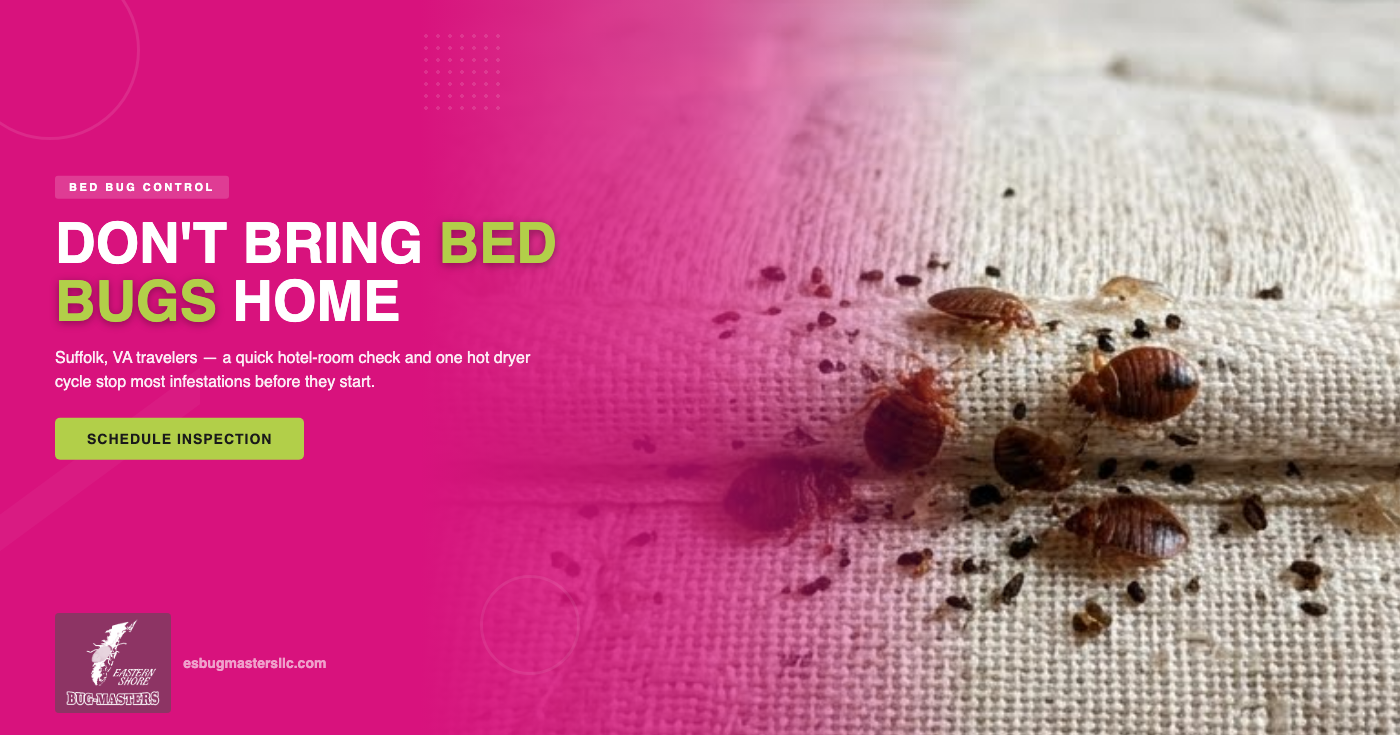
Summer in Suffolk means road trips, beach weekends down at Virginia Beach, family reunions, and weeklong vacations to places far beyond the Hampton Roads bridges. Between June and Labor Day, our neighborhoods empty out for a few days at a time and refill with sun-tanned travelers, dusty suitcases, and laundry piles that take a week to disappear. It's one of our favorite seasons — and it's also the season when bed bugs hitch the most rides home.
At Eastern Shore Bug Masters, we get more bed bug calls after the Fourth of July than at any other point in the year. The pattern is almost always the same: a Suffolk family takes a vacation, comes home, and three or four weeks later somebody wakes up with a line of itchy bites on a shoulder or ankle. By the time the first bite shows up, a small problem has usually become a much bigger one. The good news is that the entire scenario is preventable when homeowners know what to look for the moment they walk back through the door.
Bed bugs do not fly, do not jump, and don't really wander far on their own. They move the way people move. That's why hotels, vacation rentals, cruise cabins, and shared lodgings are the launching pad for almost every residential infestation we treat in Suffolk and across Hampton Roads.
Our corner of Virginia is especially exposed. Between Virginia Beach tourism, military families rotating through Norfolk and Portsmouth, cruise terminals up I-64, and college students moving in and out of dorms, this region sees an extraordinary amount of seasonal lodging traffic. According to the National Pest Management Association, only about 32% of Americans can correctly identify a bed bug, and just 30% know how to inspect a room for them. Most travelers passing through Hampton Roads hotels each summer have no idea what they're sleeping near.
The bugs themselves are tiny, flat, reddish-brown, and roughly the shape of an apple seed. They survive by tucking into the seams of mattresses, the cracks of headboards, and the folds of upholstered furniture. From there, they crawl into open suitcases, hide in folded clothes, or burrow into the lining of a backpack. By the time the suitcase gets unzipped on a Suffolk bedroom floor, the problem has already moved in.
The first ten minutes in a hotel room are the most important ten minutes of any summer trip when it comes to bed bug prevention. The U.S. Environmental Protection Agency recommends starting at the bed and working outward — the same approach works at a beachfront resort or a roadside motel.
Step one: park your luggage in the bathroom. The bathtub is a hard, smooth, well-lit surface where bed bugs cannot hide. Leave your bags there until the inspection is finished.
Step two: pull back the comforter, sheets, and mattress pad. Use your phone flashlight to check the seams and piping of the mattress, especially at the corners. Then lift the mattress and check the box spring — top and underside — and the bed frame. Pay close attention to the headboard. Many hotel headboards are wall-mounted and rarely pulled away during cleaning, which makes them a favorite hiding place.
Step three: scan the upholstered furniture. Bed bugs love sofa cushions, the seams of armchairs, and curtain hems. Look behind picture frames or wall art near the bed too.
If anything looks suspicious, do not just request a different room. Notify the front desk, ask to switch establishments if possible, and never accept a replacement room directly adjacent to, above, or below the original — bed bugs travel through wall voids and outlets.
Live bed bugs are not what most people spot first. The bugs themselves are nocturnal and very good at hiding. What we usually see during inspections — and what travelers should train their eyes to find — are the traces the bugs leave behind.
Look for small, dark, rust-colored or coffee-colored spots on the mattress seams, sheets, or behind the headboard. These are bed bug fecal stains, and they often appear in clusters or trails. Crushed bed bugs also leave reddish-brown smears that look a little like dried blood, because that's essentially what they are. Tiny pale shells the size of a sesame seed are shed skins from molting bed bugs. Small white specks the size of a pinhead are eggs.
Bites are the symptom most Suffolk families notice first at home — and unfortunately, that's late in the game. Bed bug bites usually appear in straight lines or zig-zag patterns of three or four red, itchy welts, often on the arms, shoulders, neck, or ankles. People react differently. Some develop pronounced welts within hours; others show nothing for days. If one member of the household has unexplained bites that appear in lines and only show up after sleeping, we treat that as a bed bug investigation until proven otherwise.
Even if a hotel room looked spotless, treat every returning suitcase as if it might be carrying stowaways. This single habit prevents the majority of post-travel infestations we see in Suffolk.
Before luggage comes inside, unzip it in the garage, on the porch, or in the driveway. Pull every item of clothing out — including clothes that were packed but never worn. Anything washable goes straight into the laundry on the hottest setting the fabric will tolerate, followed by at least 30 minutes in the dryer on high heat. Heat kills bed bugs at every life stage, and a hot dryer is one of the most reliable household tools against them.
For items that can't be washed — shoes, belts, books, souvenirs — a hot dryer cycle alone (without water) is still effective. A handheld garment steamer set above 130°F passed slowly over surfaces kills both bugs and eggs on contact, as the EPA notes in its Integrated Pest Management guidance.
Vacuum the suitcase interior thoroughly — seams, zipper tracks, inner pockets. Empty the vacuum canister into a sealed bag outside immediately. Then store the suitcase in a sealed plastic bag in the garage rather than under the bed or in the bedroom closet.
When a Suffolk family realizes bed bugs have moved in, the first instinct is almost always to drive to the hardware store and buy a can of spray. We understand the urge. It rarely works, and it often makes the next phase of professional treatment harder, longer, and more expensive.
Bed bugs have developed resistance to many over-the-counter pesticides, which means a heavy spray application can scatter the population without eliminating it. Bugs nesting near the bed retreat into wall voids, electrical outlets, behind baseboards, and into adjacent rooms — and the infestation goes from one bedroom to the whole second floor in days. Foggers and "bug bombs" are particularly counterproductive: they push bugs away from the treated area without reaching the deep cracks where they live and lay eggs.
DIY heat treatments have their own problems. Setting up space heaters to "cook" a bedroom is a fire hazard, rarely reaches the sustained 120°F+ needed to kill eggs in mattress cores, and can warp flooring and damage electronics. The EPA's position is clear: bed bug elimination requires Integrated Pest Management — inspection, monitoring, targeted treatments, encasements, clutter reduction, and follow-up.
When homeowners across Suffolk, Chesapeake, Portsmouth, and the rest of Hampton Roads call us after a summer trip, the first thing we do is confirm what they're dealing with. Often, what people think are bed bugs turn out to be flea bites, mosquito reactions, or skin conditions unrelated to pests. Confirming the pest is the first step, because the treatment approach is completely different for each.
A bed bug inspection from our team starts with a room-by-room visual exam, beginning at the bedrooms and working outward to any space where someone naps, reads, or watches TV. We pull mattresses, lift box springs, check behind headboards, pull dressers and nightstands away from walls, and examine the seams of upholstered furniture. We use flashlights, magnifying tools, and monitoring devices that confirm activity even when live bugs aren't visible.
Once we confirm bed bugs and identify the boundaries of the infestation, we put together a written treatment plan. That plan accounts for the layout of the home, the severity of the infestation, the pets and children in the household, and the timeline the family needs. Bed bugs require multiple visits — anyone who promises a one-and-done is overselling what is actually possible.
Some signs should trigger a call to a professional right away. If anyone in the home has woken up with multiple bites in a row or cluster pattern more than once, that's reason to schedule an inspection. If you've spotted live bugs, fecal staining on the mattress, or unfamiliar shells in the bedding, that's reason to schedule even sooner. If a family member who recently traveled is the only person being bitten, the trip is almost certainly the source.
Time is the single biggest factor in how complicated bed bug treatment becomes. A single fertilized female can produce hundreds of descendants in three months. Two weeks of delay turns a one-room treatment into a whole-house treatment. That's why we built our emergency pest control service — when our Suffolk neighbors find bed bugs, we don't make them wait.
If you're not sure what you're looking at, that's also a good reason to call. We'd rather come out and reassure a family that they're dealing with mosquito bites than have them wait six weeks and discover a full infestation. Our regular general pest control service includes inspection visits that catch bed bugs early in many homes across Suffolk. Reach out any time through the contact page on our website.
Anywhere from a few days to several weeks. A single fertilized female brought home in a suitcase can lay one to five eggs per day, and the eggs hatch in 6 to 10 days. Most Suffolk families we treat first realize they have a problem 3 to 6 weeks after returning from a trip.
Yes. Bed bugs can survive for several months without feeding, and a hot Virginia car interior is not hot enough or sustained enough to reliably kill them. If you suspect a piece of luggage is infested, do not leave it in the car. Run the contents through hot water and a high-heat dryer cycle, vacuum the suitcase, and inspect the trunk and back seat for signs that bugs have spread.
Bed bug bites are not known to transmit disease, but they can cause significant itching, allergic reactions in some people, and secondary skin infections if scratched aggressively. The bigger concern is usually the sleep loss, anxiety, and stress that come with an active infestation.
Almost never. Professionally treated mattresses combined with a high-quality bed bug encasement can typically be saved. Throwing out an infested mattress without sealing it first actually spreads the problem through the rest of the home as the mattress moves through hallways.
Most infestations are eliminated in two to three professional visits spaced 7 to 14 days apart. The follow-up visits exist because no chemical kills bed bug eggs perfectly — the second and third visits catch the newly hatched nymphs before they can mature.